
While the argument ran all weekend about whether Canada wants to join the European Union, something got leased.
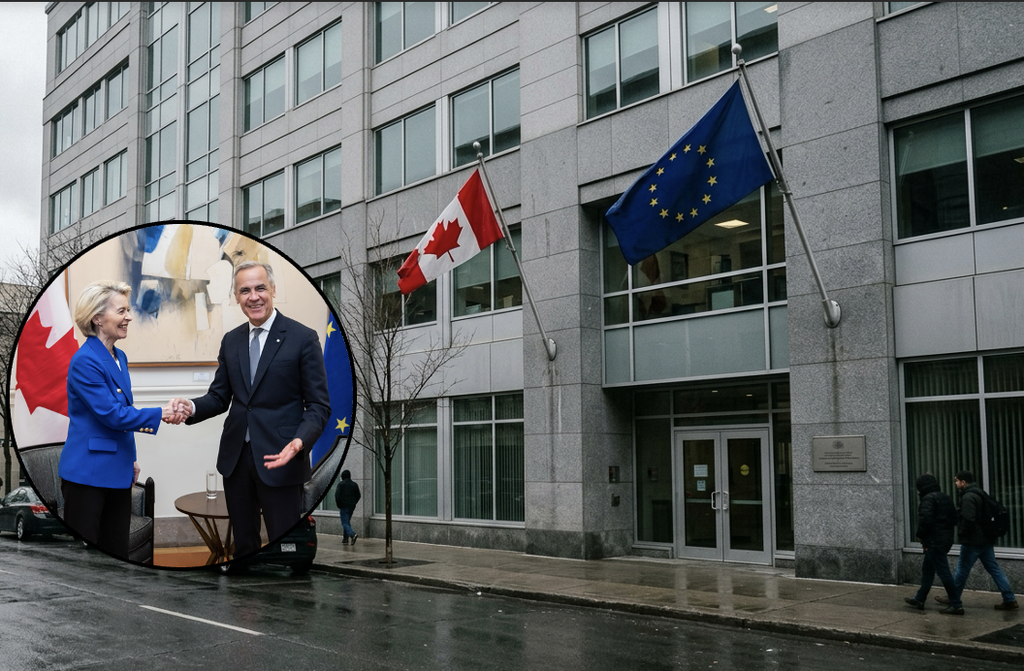
The European Parliament announced on Monday that it will open an antenna office in Ottawa. It will be the tenth such office anywhere, and the third in North America after New York and Washington.
Roberta Metsola, the Parliament’s president, framed it in a statement: Europe and Canada share values, interests and a commitment to the same rules-based international order, and the new presence in Ottawa will turn that partnership into closer parliamentary cooperation.
Note what it is not. The European Union already has an embassy in Ottawa, run by the European Commission, which is the executive branch. This is the legislature opening its own door, separately, to deal directly with Canadian parliamentarians.
On Wednesday, Carney attends Ursula von der Leyen’s State of the European Union address in Strasbourg, becoming the first head of government to do so. On Thursday he addresses the Parliament himself, at Metsola’s invitation.
The label argument
The Wall Street Journal reported on Saturday that Carney had tasked his team with identifying the most ambitious possibilities short of full membership, and had suggested Canada take the title of associate member.
Carney answered on Sunday. What Canada is pursuing, he said, is a unique alliance with the European Union. Not membership. His stated reasoning: shared values, shared priorities, complementary strengths.
A senior Canadian official told CBC on a not-for-attribution basis that the associate member label was one of several considered, that Canada did not propose it, and that the government is less concerned with the label than with what deepened ties achieve. Canada, the official said, is not trying to give up its independence for access. The shape of the relationship is expected to be sketched out more clearly at the Canada-EU summit at the end of October.
The European Union has no associate members. Its own rules state that only European countries may apply for membership.
Pierre Poilievre responded that Carney could not be more out of touch, and wrote that Canada will never be the 51st American state and never the 28th EU state. Former ambassador Stéphane Dion described membership as a non-starter for several reasons.
What the trade actually looks like
CETA has been provisionally in force since September 2017. The numbers since are the reason both sides are having this conversation at all.
Between 2016 and 2025, bilateral trade in goods grew by more than 76 per cent and trade in services by around 90 per cent, according to the Council of the European Union. Combined, trade in goods and services grew by over 81 per cent.
Canadian merchandise exports to the EU rose from $22.9 billion in 2016 to $34.6 billion in 2024, an increase of 51.1 per cent. Measured from 2015, exports are up 57 per cent. Two-way merchandise trade reached approximately C$118 billion in 2024.
The sectoral gains are concentrated. Since CETA, European imports of Canadian base metals are up 143 per cent. Minerals up 131 per cent. Energy up 70 per cent. Fertiliser, which is largely Saskatchewan potash, up 225 per cent.
In the other direction, EU goods exports to Canada increased by 26 per cent, supporting roughly 700,000 European jobs, 70,000 more than before the agreement. Forty-four per cent more European small and medium enterprises now export to Canada than did beforehand.
The investment stocks are close to balanced. European foreign direct investment in Canada stood at €244.7 billion in 2024. Canadian FDI in the EU-27 stood at €230 billion.
CETA is also the reason Canada saved an estimated $890.6 million in duties in 2021 alone, and Global Affairs has calculated that full use of CETA preferences would have saved a further $415.5 million.
What changed after January 2025
The trend predates the current dispute. What the tariffs did was accelerate it and change who was paying attention.
Bruce Dunlop, Export Development Canada’s regional vice-president for Europe, described the shift directly: EDC has been flooded with calls from companies looking for help entering new markets, and Canadian companies have realised that diversifying export markets is no longer a nice-to-have.
The aggregate numbers followed. Canadian exports to the European Union rose 23.4 per cent in 2025. Over the same year, Canadian exports to the United States fell 5.3 per cent to $564.6 billion, the first decline in bilateral trade since 2016 outside the pandemic.
The categories that fell going south were the tariffed ones. Motor vehicles and parts down 5.9 per cent. Metals and minerals, largely aluminum, down 8 per cent. Forestry and building materials down.
The categories that rose going east were the untariffed ones, and the largest destinations for those gains were France, the Netherlands, Germany, Italy and Spain.
By July 2026, non-American markets took 33.7 per cent of Canadian goods exports, and the American share fell to 66.35 per cent, down from 72.64 per cent a year earlier and the lowest since the early 1980s.
What else already exists
The parliamentary office is not the first institutional link, and it is not the most substantial.
In February 2026, Canada became the first and only non-European country admitted to SAFE, the EU’s €150 billion defence procurement programme. The United Kingdom has not been admitted. The European Union charges SAFE partners a fee calculated on expected economic spinoffs, and set a drastically lower fee for Canada than for Britain.
The first contract under it is signed. Marconi Technologies of Montreal is building made-in-Canada ORION tactical radios for the Polish Cyber Command, drawing on roughly 100 Canadian suppliers, with deliveries running to 2030.
Canada has been the European Space Agency’s only non-European cooperating state since 1979, and joined Horizon Europe, a €93 billion research programme, in 2024. In May, Carney became the first non-European leader to take part in the European Political Community Summit, in Armenia.
Canada and the EU also already have a Strategic Partnership Agreement, a Digital Partnership and a Security and Defence Partnership.
In energy, two German utilities have signed twenty-year LNG supply agreements with the Ksi Lisims project on the northern British Columbia coast. SEFE took one million tonnes a year in May. Uniper signed for two million tonnes a year in July, for delivery to Germany, the UK, Sweden and the Netherlands.
The constraints
Three, and they are structural rather than political.
CETA is still not fully ratified. As of 2025, seventeen EU member states had completed their national ratification processes. Ten had not: Belgium, Bulgaria, Cyprus, France, Greece, Hungary, Ireland, Italy, Poland and Slovenia. The agreement has been provisionally applied for nine years.
The European Union also signed a trade agreement with the CPTPP in 2016 that ten member states have yet to ratify, including France and Italy.
And Geneviève Tuts, the EU’s ambassador to Canada, noted earlier this month that it is easier in the Canada-EU relationship to come up with big pronouncements of new initiatives than to actually follow through on them. Only one project has emerged from SAFE for Canada so far.
What the office represents
The European Parliament has 720 members drawn from 27 countries representing roughly 450 million people. It approves trade agreements, scrutinises the Commission, and can block ratification.
Opening a permanent presence in Ottawa gives Canadian parliamentarians a standing channel into that body, and gives European members a reason to think about Canada between summits.
Membership was never on the table, and the government has said so. The office is on a lease.
Sources
- European Parliament to open Ottawa office as Carney seeks ‘unique alliance’ with EU, CBC News
- EU-Canada trade: facts and figures, Council of the European Union
- Factsheet: EU-Canada trade agreement (CETA), European Commission
- CETA and Canada-U.K. free trade agreements open doors to Europe, Export Development Canada
- Trade Partner Profile: The European Union, Signal49 Research