
For decades the reason to invest here was access to the market next door. This week the pitch changed to something else entirely.
In 2022, Canada lost money. Forty-nine billion dollars more investment left the country than came into it.
That is the number worth holding onto, because it explains why this week is happening at all.
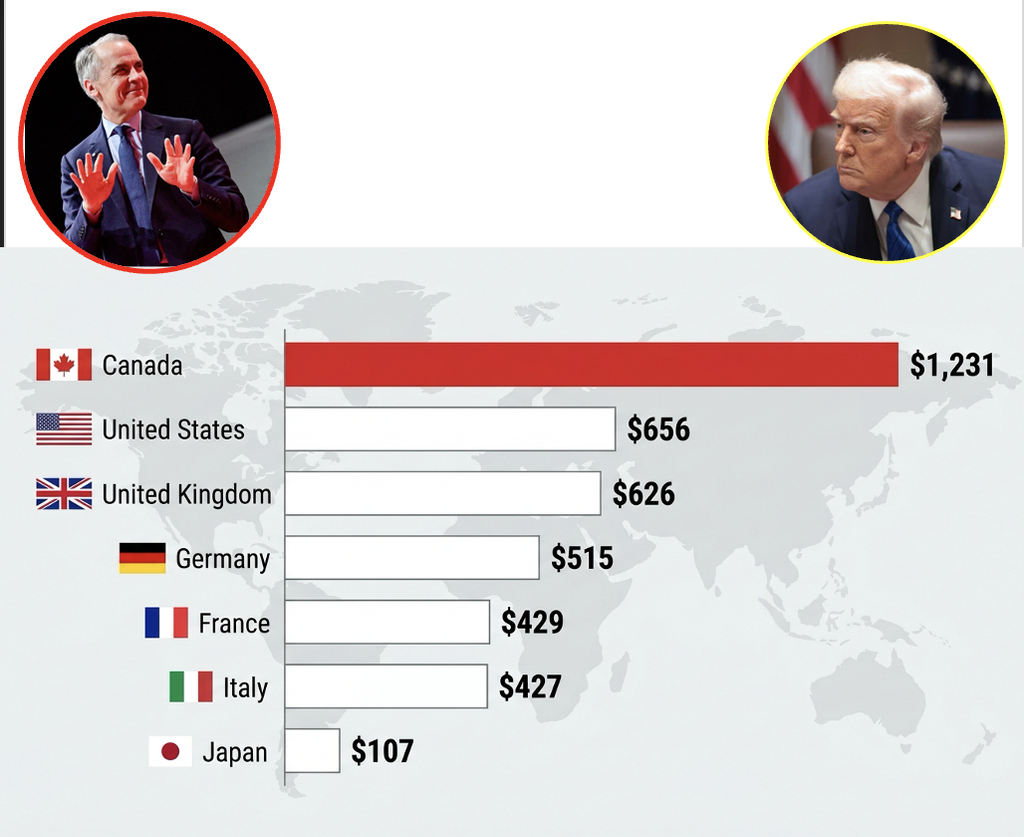
Last year foreign direct investment into Canada reached C$96.8 billion, the highest level since 2007, and net inflows exceeded outflows by $17.4 billion. Canada now ranks second in the world on Kearney’s FDI Confidence Index, behind only the United States, and records the highest inflows per capita in the G7.
A swing of roughly $67 billion in three years.
There is a caveat, and it comes from C.D. Howe rather than from anyone hostile to the government. Nearly half of that record, $43.6 billion, arrived through mergers and acquisitions, which buys existing assets rather than building new factories, equipment or jobs. Another large share was reinvested earnings.
Which is precisely what this week’s summit is meant to change.
The ask
The target is C$1 trillion over five years, roughly 723 billion US dollars.
The mechanism, which almost nobody is quoting, is $280 billion in government capital investments and incentives meant to draw the rest in. That ratio is what makes the number credible or not, and it is the figure to watch rather than the headline.
For scale: C$1 trillion over five years means roughly doubling last year’s inflows, every year, for five years.
The room
The summit opened in a downtown Toronto hotel and runs two days, deliberately scheduled during the film festival when the city is already full of international arrivals.
It is co-hosted by the Prime Minister’s Office with CPP Investments and PSP Investments, two of the largest asset managers in the country. One official told Bloomberg the room holds the largest collection of assets under management ever assembled in Canada. The Globe put the figure at close to $120 trillion across the invited institutions.
Before the opening dinner, Carney met the chief executives of Macquarie and Temasek. Then he joined Saskatchewan Premier Scott Moe to announce an investment in Canadian data sovereignty.
The premiers arrived with lists. Danielle Smith brought 34 proposed Alberta projects. Susan Holt is pitching a port expansion, a data centre at Lorneville and the Mactaquac power plant rehabilitation. Moe is selling energy, critical minerals, defence and agriculture, and hosting a separate forum on uranium and nuclear.
More than 160 projects are on the table across energy, mining, defence and power. Montreal-based Deep Sky is seeking $328 million for a carbon removal facility in Alberta. These are described as shovel-ready rather than conceptual, which is the distinction that determines whether a summit produces anything.
The problem being solved
Canada’s weakness here is not a secret and the government does not pretend otherwise. Carney has called weak business investment the country’s Achilles heel, and fixing it is the entire reason this event exists.
Canadian business investment per worker has lagged the American equivalent for most of two decades. Productivity growth has been correspondingly poor. Every government since at least 2015 has identified the problem and none has solved it.
What is new is not the diagnosis. It is the argument being made to fix it.
The pitch
Speaking in Banff last week, Carney previewed it. Canada, he said, is about so much more than being next to the United States. We have what the world wants.
There is a market for that sentence, and it is larger than most coverage suggests.
Amundi, Europe’s largest asset manager with $2.7 trillion under management, says clients have been asking to diversify away from American assets since April 2025, and that the trend accelerated after tariff threats aimed at eight European countries. Europeans hold roughly $10.4 trillion in American stocks, about half of all foreign-held US equities.
Capital looking for somewhere else to sit is not a theory. It is the largest single fact in global markets right now, and the Financial Times gave this week’s event a headline Ottawa would never have written and will not object to: Canada seeks $1tn from investors looking for a haven from Donald Trump.
What it looks like when it works
Saskatchewan already has a number.
Its exports to the United Kingdom are up almost 178 per cent over five years, driven by uranium, which accounted for about 57 per cent of everything the province sold there in 2025.
That is not a forecast or a target. It is what happened when a Canadian commodity found a buyer outside North America and the relationship held.
This also sits on top of a year of institutional building that has attracted very little attention. The C$2 billion Sovereign AI Compute Strategy. The C$5 billion Trade Diversification Corridor Fund. The Canada Strong Fund, a $25 billion sovereign wealth vehicle mandated to take minority equity stakes alongside private capital. Roughly $500 billion in private investment already committed to ports, mines and energy corridors through the Major Projects Office.
The objections
Three, and they deserve stating properly.
Not everyone wants this money spent this way. Wet’suwet’en hereditary chiefs, Gitxsan leaders and the Union of British Columbia Indian Chiefs have publicly objected to megaprojects that could be financed out of this summit, including LNG developments facing final investment decisions this year. Labour unions, climate groups and housing advocates have organised around the event. A summit that produces $1 trillion in commitments will also produce consent fights, and some of them are already underway.
Announcements are not investments. Carney has teased signed deals without naming them. The reliable measure is financed project announcements in the months afterward, not the framing on opening day. Canada has held investment summits before.
And the composition problem does not fix itself. If the trillion arrives the way last year’s $96.8 billion did, with nearly half of it buying existing assets, it will not move productivity at all. The government’s own $280 billion is aimed at greenfield construction, which is the right target. Whether the private capital follows into the same category is the open question.
What changed
For decades the argument for putting money into Canada was straightforward and everybody understood it. Canada is stable, resource-rich, well-governed, and sits beside the largest consumer market on earth with a trade agreement guaranteeing access to it.
That last clause did most of the work.
This week the argument is different. Stability, rule of law, resources the world needs, and a jurisdiction that is not the United States.
It is a weaker pitch in some ways and a stronger one in others, and which it turns out to be depends entirely on how long international investors think the current arrangement in Washington is going to last.
Sources