
France pulled its last 129 tonnes of gold out of New York. The Dutch moved 86 more. Norway wants to cut $80 billion in Treasuries, and Canada’s pension funds just committed $100 billion at home instead.
How the vault came to be in New York
The arrangement now being unwound was built in a hotel in New Hampshire.
In July 1944, with the war still running, delegates from 44 countries met at Bretton Woods to design what came next. The problem they were solving was the 1930s: competitive devaluations, capital controls, trade collapsing into blocs. The solution was to fix every currency to the dollar, and the dollar to gold at $35 an ounce.
That made the United States the anchor of the system by construction. Other countries held dollars because dollars were as good as gold, and the American government promised to convert them on demand.
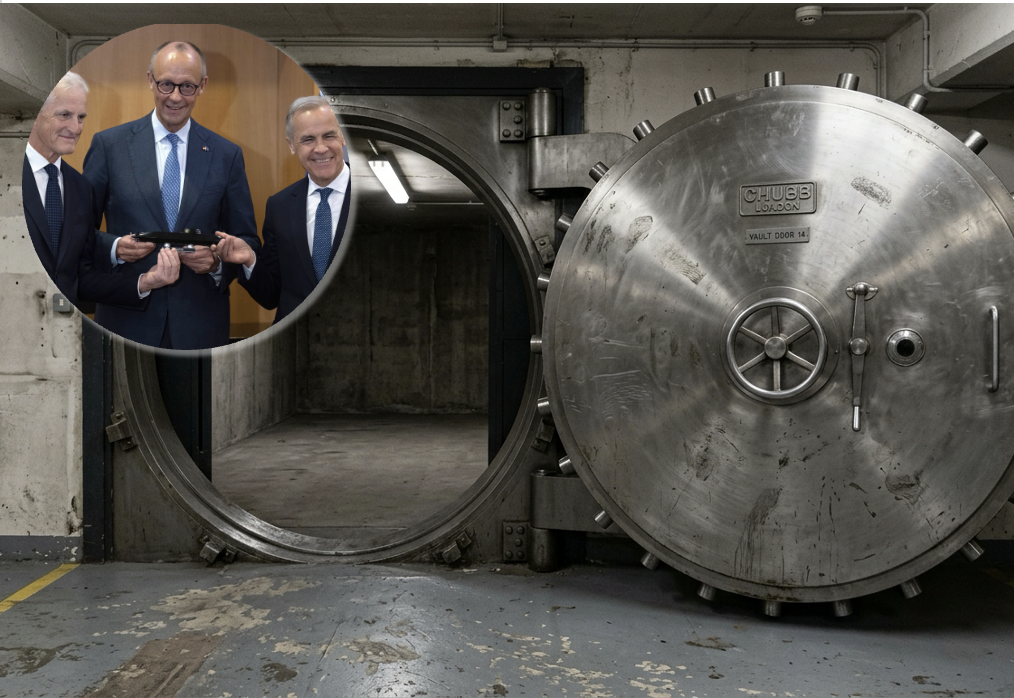
It also made New York the natural place to keep the gold itself. The Federal Reserve Bank of New York had been storing foreign gold since the 1920s, and after the war the volume grew enormously. European countries whose vaults had been overrun, looted or bombed had strong reasons to keep reserves somewhere that had not been invaded. The Fed’s vault, 25 metres below Liberty Street and resting on Manhattan bedrock, became the largest known gold repository in the world.
The Fed does not own any of it. Its own public description is that it acts as guardian and custodian on behalf of account holders: the American government, foreign governments, other central banks and international organisations. No individual or private entity may store gold there.
At its peak in 1973 the vault held over 12,000 tonnes.
Nixon ended dollar-gold convertibility in 1971 and Bretton Woods formally collapsed, but the habit outlasted the treaty. The dollar remained the reserve currency because everyone else’s reserves were already denominated in it, and because American Treasuries were the deepest, most liquid market on earth. If you needed to sell $10 billion of something at three in the morning, Treasuries were the only asset that could absorb it without moving the price.
That is what “risk-free asset” actually meant. Not that America could not default, but that you could always get out.
None of it ever rested on interest rates. It rested on an assumption about behaviour: that the United States would remain predictable, and that what you stored there would still be yours tomorrow.
The moment the assumption was tested
February 2022. Within days of the invasion of Ukraine, the United States and its allies froze roughly $300 billion of Russian central bank reserves.
It was legally justified and, in the view of most Western governments, morally obvious. It was also unprecedented in scale, and every reserve manager on earth watched it happen.
The lesson was not that Russia had been wronged. It was narrower and more uncomfortable: reserves held in another country’s jurisdiction are not simply assets. They are assets held at the pleasure of that country’s government.
Central banks are institutionally cautious, slow-moving and allergic to drama. They are also paid to think about tail risks. Once a precedent exists, it has to be priced.
What has happened since
France. Between July 2025 and January 2026, the Banque de France withdrew every remaining ounce it held at the New York Fed. The last 129 tonnes, moved across 26 separate transactions.
The mechanism matters, because it was not a shipment. Non-standard bullion held in New York was sold, and London Good Delivery bars were purchased within Europe to replace it. The operation realised a capital gain of €12.8 billion, possible because gold held in New York traded at a premium during the period.
France holds 2,437 tonnes in total, the fourth-largest national reserve in the world, and roughly 82 per cent of its foreign reserves.
The Netherlands. Between March and August 2026, De Nederlandsche Bank moved 86 tonnes out of North America: 78 from New York and seven from Ottawa.
The proportions tell it better than the tonnage. New York’s share of Dutch gold fell from about 31 per cent to 18.5. London’s rose from 18 to 32.1. Ottawa also sits at 18.5.
The total Dutch reserve did not change. It remains 612.4 tonnes. Nothing was sold; it was relocated.
DNB’s stated reason was an increasingly volatile geopolitical environment and the need to spread reserves so they can be mobilised in a crisis. Across a series of reorganisations concluding this year, the Dutch have cut the share held in New York and Ottawa from over 70 per cent to 37.
Norway. Norges Bank Investment Management, which runs the world’s largest sovereign wealth fund, has proposed cutting government bonds from 70 per cent of its fixed-income benchmark to 50. That change could shift as much as $80 billion away from American Treasuries.
Canada. The big public pension funds — CPP Investments, the Caisse, PSP, BCI, Ontario Teachers’ and the others — manage roughly $2.5 trillion between them. For three decades a very large share has sat in American infrastructure, real estate and private equity, because that is where the returns were.
At Canada’s first Investment Summit in Toronto last week, several of them committed to something different. CPP Investments and Brookfield launched a $50 billion Maple Fund, $25 billion each, targeting critical infrastructure and strategic industries inside Canada, with a minimum investment size of $5 billion. PSP committed a further $25 billion domestically, raising its Canadian portfolio to $100 billion. British Columbia Investment Management is growing domestic holdings to $145 billion by 2030. Ontario Teachers’ added $10 billion by the end of 2027. Sun Life, $5 billion over five years.
Canadian pension funds and insurers committed close to $100 billion in new capital to Canadian assets over two days.
Nobody used the word America. They did not need to.
The aggregate picture
Individual decisions are anecdotes. The survey data is the trend.
Gold has now overtaken US government bonds as the world’s largest reserve asset.
The World Gold Council’s 2026 central bank survey, conducted between February and May, found that 93 per cent of responding central banks hold gold, up from 81 per cent a year earlier. A record 45 per cent expect to increase their own holdings within twelve months. A record 90 per cent cite gold’s performance during crises as a reason for holding it, while the share citing historical legacy has fallen to 46 per cent from 62 in 2025.
Seventy-four per cent expect the dollar’s share of global reserves to be lower in five years.
On storage: the Bank of England is used by 57 per cent of respondents, domestic vaults by 49 per cent, the Bank for International Settlements by 16, and the New York Fed by 14.
Central banks have bought an average of 1,000 tonnes a year over the past four years, against a 500-tonne average over the preceding decade.
Three arguments that this means less than it appears
Everyone has a technical explanation, and the explanations are good. Liquidity, tradability, crisis readiness. London and New York remain popular precisely because gold held there sits inside major settlement networks, giving reserve managers immediate market access without needing bars recertified. Goldman Sachs makes exactly this point: the reason central banks keep significant quantities in both places is that they can actually sell it.
The price moved enormously. Gold has gone from roughly $2,600 an ounce at the end of 2024 to around $4,300. An asset that rises by more than half forces a rebalance in any portfolio, regardless of politics. France’s withdrawal was profitable, which is not an accusation but it is a fact.
And this is diversification rather than repatriation. This is the finding most coverage gets backwards. The same World Gold Council survey found that 10 per cent of central banks spread gold into additional foreign jurisdictions over the past year, against 9 per cent who increased domestic storage. More are adding custodians than bringing metal home. The Dutch moved gold from New York to London, which is not sovereignty. It is spreading.
The WGC also cautions that 20 per cent of respondents declined to answer the vault-location question this year, which makes year-on-year comparisons noisier than the headline numbers suggest.
There are further qualifications on the money side. Norway’s proposal is a recommendation the Finance Ministry has not acted on, with no implementation timetable, and the fund’s total dollar exposure would barely change because the Treasury reduction is offset by buying other American bonds. Canada’s pension commitments are new capital directed homeward, not existing positions liquidated. Canadian holdings of US Treasuries actually rose by $23.8 billion in the most recent month on record.
Three arguments that it means more
The precedent is the thing that changed. Nothing about American creditworthiness has shifted. What shifted in 2022 was the demonstrated willingness to use custody as an instrument of policy. That cannot be un-demonstrated, and it applies to every holder, not only to adversaries.
The direction is consistent across unrelated institutions. A French central bank, a Dutch central bank, a Norwegian sovereign fund and a set of Canadian pension managers do not coordinate. They have different mandates, different governance and different time horizons. When they move the same way within eighteen months, the common variable is external.
And the composition of reserves is changing, not just their location. Gold passing Treasuries as the world’s top reserve asset is a structural fact, not a storage decision. So is 74 per cent of surveyed central banks expecting a smaller dollar share within five years. Neither is explained by a price move or by vault logistics.
What it actually is
Individually, each of these is portfolio management with a defensible technical rationale, executed by people who would be professionally embarrassed to frame it politically.
Collectively, across four countries, eighteen months and roughly $2.5 trillion of institutional money, it is a hedge.
The dollar is not being replaced. No currency is positioned to replace it, and the gold market is a fraction of the size of the Treasury market. Anyone claiming otherwise is selling something.
But hedging is not replacing. A hedge is what you build when a bad outcome has become slightly more likely than it used to be, and when preparing costs little relative to being caught out.
The question was never whether America’s allies trust it today. Most of them plainly do.
It is why, for the first time since 1944, several of them have quietly started building the capacity not to.
Sources