
The company cancelled its planned American factory over tariffs in the same year it poured concrete in St. Thomas. Germany’s economy minister went to Ottawa to talk about expanding further.
For most of the last century Canada was a place German carmakers sold into, not a place they built in.
That is not a small distinction. Volkswagen has sold vehicles in Canada for decades, through dealer networks across every province, and in all that time it never manufactured a single car here. Neither did Mercedes-Benz or BMW. The German industry treated Canada as a market, and treated the United States, Mexico and later China as places to put factories.
There were reasons. Canada’s domestic market is roughly a tenth the size of the American one, and under the Auto Pact and then NAFTA a plant in Michigan or Puebla served the whole continent. Building in Canada meant building for a small market or accepting border friction on the way to a large one.
That logic held for fifty years. It is now being tested from both ends at once.
The phone call
The shift began, improbably, with a cold call.
In March 2022, Industry Minister François-Philippe Champagne asked his staff to find a number for Volkswagen’s North American chief executive, a man he had never met. He rang him on St. Patrick’s Day.
His own account of the conversation, given later to the Canadian Press: “I introduced myself, and I said, ‘Listen, here I am, Minister Champagne from Canada. I would like to start a discussion.'”
A meeting in Toronto followed just over a month later. Ontario’s economic development minister, Vic Fedeli, was in the room to help make the first pitch.
In August 2022, Ottawa signed memorandums of understanding with both Volkswagen and Mercedes-Benz covering batteries, cathode materials and critical minerals, with German Chancellor Olaf Scholz in attendance. The pitch was straightforward: Canada has the nickel, cobalt, lithium and graphite that battery cells require, a clean electricity grid, and a workforce already trained in automotive assembly.
A year of negotiation followed.
What was actually agreed
In March 2023, PowerCo, Volkswagen’s battery subsidiary, selected St. Thomas, Ontario.
The numbers are worth stating precisely, because they get conflated constantly.
The capital cost of the plant is around $7 billion. The headline figure of roughly $14 billion, which appeared in most coverage, is the total value of the package including production subsidies paid over the life of the facility, structured to match American Inflation Reduction Act incentives so that Canada was not simply outbid. Federal capital support was $700 million. Ontario contributed $500 million.
The site is 350 acres. At full build it is designed for up to 90 gigawatt hours of cell production a year by 2030, enough for roughly one million vehicles annually. Up to 3,000 direct jobs.
It is PowerCo’s first battery cell plant outside Europe, and its largest anywhere in the world.
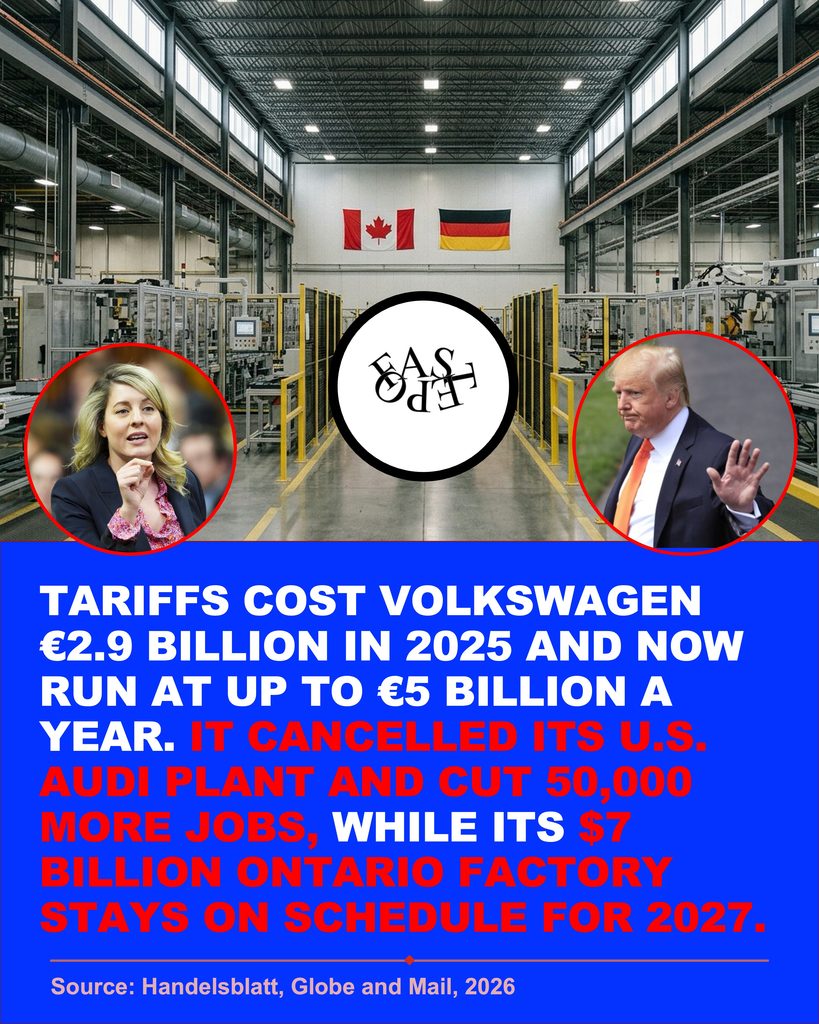
Concrete went down in October 2025. Production is scheduled to begin in 2027.
So the first Volkswagen manufacturing facility in Canadian history is not a modest assembly line. It is the company’s biggest single bet on battery production on any continent.
Then January, and the other direction
In January 2026, Volkswagen’s chief executive gave an interview to Handelsblatt about a different factory.
Oliver Blume said the company would not proceed with its planned Audi plant in the United States unless automotive tariffs came down significantly. His reasoning was arithmetic rather than politics: given an unchanged tariff burden, large additional investment cannot be funded.
The burden by then was €2.1 billion, about $2.5 billion, accumulated in the first nine months of 2025 alone.
This is the part of the tariff story that gets least attention. The stated purpose of automotive tariffs was to make building in the United States more attractive than building elsewhere. What Blume was describing is the opposite mechanism: the tariffs were consuming the capital that would have funded the American plant.
A company paying €2.1 billion in duties has €2.1 billion less to spend on factories, including factories in the country collecting the duties.
Ottawa, the same month
While Blume was explaining why the American plant would not proceed, Germany’s federal economy minister, Katherina Reiche, was in Ottawa.
She said the German automotive industry is willing to invest in Canada because it will find good conditions here, and that talks were under way to extend its footprint beyond the PowerCo facility.
Asked whether this amounted to anything concrete, her answer was that it is more than just talking. They are looking into numbers, into details.
She pointed to the plant already going up in St. Thomas as evidence that Canada is a reliable partner.
Two statements about the same company, in the same month, pointing in opposite directions.
What has happened since
January now looks conservative.
Volkswagen posted its first quarterly loss in five years, €1.07 billion. Its finance chief attributed a combined €7.5 billion hit to higher tariffs, a changed Porsche strategy and writedowns.
Tariff costs reached €2.9 billion for 2025 and now run at up to €5 billion a year.
On September 3, the company announced it would cut 50,000 more jobs globally, on top of 50,000 already planned in Germany by 2030. Roughly half of the new cuts land in Germany. Up to four German plants are at risk. The model range is to be halved by 2035.
German employment at the company has already fallen from 275,000 in 2023 to 254,000 as of June.
Why the tariffs bite this company so hard
The mechanics are specific and they explain the scale of the damage.
Volkswagen builds approximately 200,000 cars a year at its American plants. It imports roughly 240,000 from Europe, facing a 15 per cent tariff, and 287,000 from Mexico, facing 27.5 per cent.
So of the cars Volkswagen sells in the United States, the majority cross a border to get there, and the tariff lands on every one of them.
A tariff designed to reward domestic production punishes hardest the companies with the most to move. And moving takes years: a new assembly plant is a five-year project even when the capital is available, which is precisely what the tariffs are consuming.
What it means for Canada
It would be easy to overstate this, so the qualifications matter.
Canada is not replacing the United States as a destination for German automotive investment. The American market is ten times larger and will remain the primary target. St. Thomas was negotiated before the current tariffs existed, in competition with American incentives rather than in flight from American policy.
The plant is also not complete. Production begins in 2027 at the earliest, battery cell manufacturing is notoriously difficult to bring to full yield, and Volkswagen has cancelled or delayed battery projects elsewhere, including an $11 billion EV and battery project in Ontario that remains suspended.
And Reiche’s comments were a minister expressing willingness, not a signed agreement.
What can be said is narrower and still significant. A German manufacturer that never built anything in Canada in seventy years is now building its largest battery facility in the world here, has cancelled a planned American factory over tariff costs, and its government’s economy minister has told Ottawa the industry is looking at doing more.
The ledger
The policy was designed to move automotive production into the United States.
The observable results at one company, eighteen months in: a cancelled American factory, 50,000 additional job cuts globally, €5 billion a year in tariff costs, a first quarterly loss in five years, and a German economy minister in Ottawa discussing expansion.
Meanwhile the concrete keeps going down in St. Thomas.
Sources