
In May, Ottawa chose a Swedish surveillance jet for the Arctic over two American rivals. In September, two Swedish CB90 assault boats crossed the Atlantic for the Canadian Armed Forces to test: 40 knots, 18 troops each.
On the twenty-seventh of May, at the CANSEC defence trade show in Ottawa, Prime Minister Mark Carney announced that Canada would negotiate to buy its next airborne early warning aircraft from Sweden.
The winner was Saab’s GlobalEye. The losers were two American competitors: Boeing’s E-7 Wedgetail and L3Harris.
“The GlobalEye procurement will help us secure our North and build our economy at once,” Carney said.
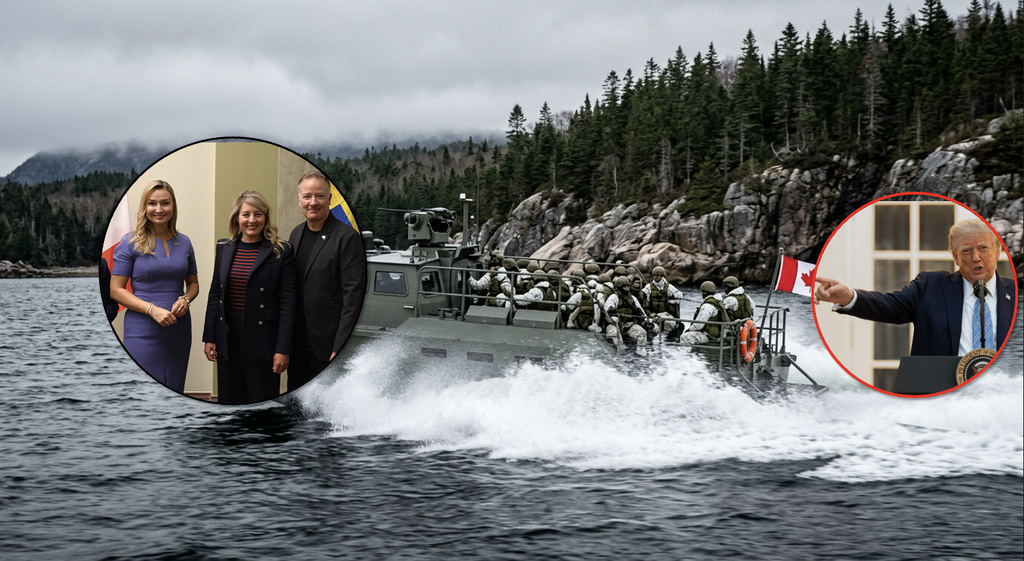
Four months later, a second Swedish platform arrived. The Swedish Navy lent the Canadian Armed Forces two Stridsbåt 90 combat boats, known internationally as the CB90, for evaluation. Canadian crews had spent the summer training in Gothenburg.
One is a plane that watches the Arctic from the air. The other is a boat that puts soldiers on a shoreline. Both are Swedish.
The Plane
The GlobalEye is an airborne early warning and control aircraft: a flying radar station that watches the sky and the sea and passes what it sees to commanders on the ground.
Its main sensor is a long, flat radar mounted along the top of the fuselage. Canada’s own figures:
- Detection range: objects up to 650 kilometres away
- Role: Arctic surveillance and Canada’s contribution to NORAD
- Fleet: six aircraft
- Value: more than C$5 billion (about US$3.6 billion)
On the twenty-fifth of September, Saab and Ottawa signed a term sheet to move into full contract negotiations. No contract has been signed yet.
Then there is the airframe. The GlobalEye is not built on a Swedish jet. It is built on the Bombardier Global 6500, a business jet manufactured in Toronto.
Carney went further. He pledged that at least one-third of projected GlobalEye orders from allied countries, roughly 40 aircraft over 15 years, will be assembled in Canada.
Saab’s chief executive described the deal as offering “sovereign ownership for Canada and comprehensive and skilled work for Canadian industry.”
The choice did not go unnoticed in Washington. The Trump administration had already suspended a joint defence advisory board with Canada after disputes over Ottawa’s review of its F-35 purchase.
The GlobalEye is part of a much larger plan. Ottawa has outlined about C$180 billion in defence procurement over ten years, with a stated aim of building more at home and relying less on any single supplier.
The Boats
The CB90 is one of the most recognisable small military craft in the world.
It was designed in Sweden for the country’s rocky, island-filled coastline, where large ships cannot go. The numbers:
- Speed: about 40 knots, with the newer version reaching 45
- Troops: 18 fully equipped soldiers per boat
- Range: about 300 nautical miles
- Draught: under a metre, 0.8 to 0.9 m, so it can work in very shallow water
- Propulsion: twin waterjets, which let it stop, turn and reverse almost on the spot
- Length: about 16 metres (newer version)
Sweden has built more than 120 for its own navy since 1990. Others use it too:
- Norway: 20
- Mexico: more than 40, including boats built under licence
- Malaysia: 17
Saab builds the boats at its yard in Docksta, in northern Sweden.
Canada’s interest is specific. According to the evaluation reporting, the Canadian Armed Forces want to see whether the CB90 can fill the gap between small rubber assault craft and larger naval vessels: something fast enough to move troops along a coast, small enough to reach a beach, and tough enough for rough water.
The trials measure transit speed, shallow-water handling and how quickly troops can load and unload.
The groundwork was laid in Sweden. Over the summer, Canadian crews trained with the Älvsborg Amphibious Regiment in Gothenburg, one of two regiments in Sweden’s Amphibious Corps. Then the boats were shipped across the Atlantic.
No purchase has been committed. But the idea is not new. A 2022 Canadian concept looked at buying 20 of the newer CB90 boats at about $3 million each, providing about 360 troop seats for light infantry operations along Canada’s coasts.
Canada has the longest coastline of any country in the world.
Sources
- Canada chooses Sweden’s Saab in defence deal over US rivals — Euronews, 27 May 2026
- Canada wants Saab early-warning aircraft under push to retool defense suppliers — Defense News, 28 May 2026
- Canada turns away from U.S. on major defence purchase — CTV News
- Canada, Saab to enter full negotiations for six GlobalEye AEW&C aircraft — FlightGlobal, 25 September 2026
- Canada takes next step towards acquisition of six GlobalEye — Nordic Defence Sector
- Sweden lends Stridsbåt 90 combat boats to Canada — Nordic Defence Sector, 21 September 2026
- Canada tests Swedish CB90 fast assault craft for future amphibious operations — Army Recognition
- CB90-class fast assault craft — Wikipedia