
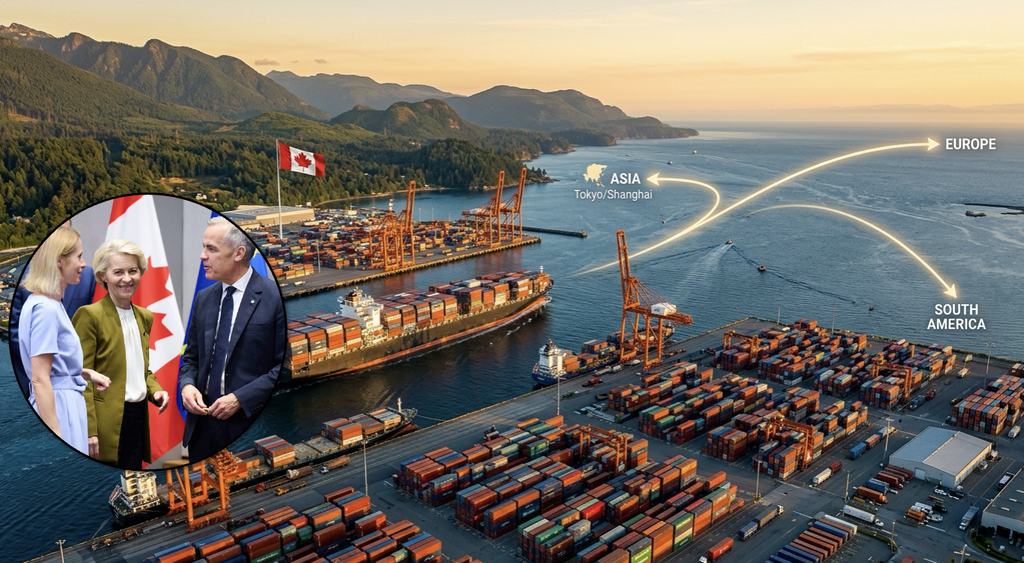
In 2025, 32.8% of Canada’s exports went to countries other than the United States, the highest share since 1981. The shift is real, but it is uneven, part of it is gold, and it isn’t finished.
In August, the White House published a document titled “President Trump Is Finally Ending Canada’s Free Ride.” It listed eleven numbered points and closed with Donald Trump’s line that Canada feels entitled but is not a State and will be entitled no longer. One of its central claims was that Canada depends on the United States, because about three-quarters of Canadian exports go south.
For most of the past 40 years, that was close enough to the truth. At its peak, in 1999 and 2000, the United States bought 80.8% of everything Canada sold abroad. For a generation, Canadian trade policy was in practice American trade policy, and the rest of the world was a rounding error.
That is changing faster than at any time in decades.
Global Affairs Canada’s annual State of Trade 2026 report, released in September, shows that the share of Canadian exports going to countries other than the United States reached 32.8% in 2025, the highest level since 1981. Counting goods and services together, the US share fell to 67.2%. For goods alone, the share going to the United States was 72%, which is where the White House’s “three-quarters” comes from, and that number is falling too. Monthly data from Statistics Canada show that in July 2026, the United States took 71.7% of Canada’s merchandise exports, down from 75.9% a year earlier.
The headline numbers for 2025 are these. Exports to the rest of the world rose 11.1%, an increase of $33.3 billion. Non-US goods exports alone rose $32.8 billion, the largest dollar increase on record. Exports to the United States fell 3.7%, a drop of $26.3 billion. Foreign direct investment into Canada reached $93 billion, well above its ten-year average of $57.8 billion and more than the $73.8 billion Canadians invested abroad.
Where the growth went tells a more detailed story.
The biggest jump was in the United Kingdom, where Canadian exports rose 50%, an increase of $20.4 billion, to $61.2 billion. Most of that was gold. Gold shipments to the UK rose $17.4 billion, most of them headed for London’s bullion market.
The European Union is the more durable story. Canadian exports to the EU rose 16.4%, or $9.5 billion, to $67.7 billion. Goods exports to the EU rose 23.5%, the largest increase on record. Exports to Germany rose 24.3% and to the Netherlands 28.2%. The products behind it were crude oil, much of it from offshore Newfoundland and Labrador, which added $1.8 billion; aluminum, which added $1.5 billion as American tariffs pushed Canadian smelters toward Europe; and canola seed, which added $0.7 billion.
Exports to China rose 11.8%, or $4.7 billion, to $44.7 billion, driven by $4.0 billion more crude oil, much of it shipped through the expanded Trans Mountain pipeline to the Pacific coast, and $1.5 billion more copper ore.
The wider Indo-Pacific region grew more modestly, by 4.6% to $113.8 billion. Exports to Singapore and Indonesia each rose about 28%. Exports to India, South Korea and Japan fell.
Ottawa’s stated goal is to double non-US exports by 2035.
The Part Tariffs Can’t Reach
The least-noticed part of the report is about services.
Services are what Canada sells that isn’t a physical good: engineering and consulting, software and digital work, finance and insurance, transportation, and the spending of tourists and international students in Canada. In 2025, Canadian services exports reached a record $240.5 billion, up 3.8%, nearly triple their level of 15 years ago. They now make up almost a quarter of everything Canada sells abroad.
The breakdown shows how broad they are. Commercial services, the category that covers business, professional, technical, financial and digital work, brought in $144 billion. Travel services, mostly spending by visitors and students in Canada, brought in $72 billion. Transportation brought in $23 billion.
Services also explain most of Canada’s recent export growth. According to the report, services have been the sole driver of Canada’s $50 billion in export gains since 2022. Digitally delivered services, which now make up 13% of all Canadian exports, have grown about 200% since 2010, compared with 92% for goods.
There is a simple reason services matter in a trade war. Tariffs are built for goods crossing a border at a customs post. Services mostly cross through contracts, networks and people, and they have largely escaped the tariffs. In 2025, while total Canadian exports to the United States fell, services exports to the United States rose 6.9%, an increase of $8.3 billion.
Services are also far less dependent on the American market to begin with. Just 53% of Canada’s services exports go to the United States, compared with 72% of its goods. Nearly half are sold elsewhere. India alone takes 6% of Canada’s services exports, more than its share of goods, largely because of the students and professionals moving between the two countries. Services exports to the EU grew 5.8% last year, faster than to any other region.
Investment points the same way. Foreign companies put $93 billion of new direct investment into Canada in 2025, the highest level in years and well above the ten-year average. For the first time since 2013, more investment came into Canada than Canadian companies sent out.
What the Numbers Don’t Show
The report is not a victory lap, and it shouldn’t be read as one.
Start with gold. Canada exported $53.3 billion of gold in 2025, making it the country’s second-largest commodity export after crude oil. Gold now makes up 6.8% of all Canadian goods and services exports, up from 1.3% in 2007. But most of the 2025 increase came from price, not volume. Gold export prices rose 45.2% while the volume shipped fell 6.3%. Gold moves where the bullion markets are, it rises and falls with world prices, and it says little about whether Canadian manufacturers are finding new customers. Take the gold out, and the shift away from the United States is real but noticeably smaller.
The wider economy also had a difficult year. Export volumes fell 1.4% in 2025, the first annual decline since 2009 outside the pandemic. Canada’s overall trade deficit widened to $29 billion, the largest since the pandemic. Real GDP grew 1.9%, the slowest pace since the pandemic. Diversification has so far softened the damage from American tariffs. It has not replaced what was lost.
Some markets went backwards. Exports to India fell 7.2%, to South Korea 5.4% and to Japan 2.2%. Chinese tariffs on Canadian canola and other farm products held back sales in Asia, until Ottawa and Beijing reached a deal in January 2026.
Monthly data can also swing hard. In August 2026, Canadian exports to the United States jumped 8.1% as companies rushed shipments south before new 50% tariffs took effect on the 22nd of August, pushing Canada’s monthly trade surplus with the US to $11.2 billion. In the same month, exports to other countries fell 8.5%. One month of front-loading can briefly reverse a trend that took a year to build.
And the United States remains, by a very wide margin, Canada’s largest customer. Two out of every three dollars of Canadian exports still go there.
What Ottawa is betting on is the next set of agreements. Canada is aiming to conclude three trade deals before the end of 2026. With India, the fifth round of talks was held in Ottawa from the 5th to the 9th of October, and both sides are aiming to finish by the G20 summit in December. With Mercosur, the South American bloc of Brazil, Argentina, Paraguay, Uruguay and Bolivia, Foreign Minister Anita Anand has said the goal is to conclude negotiations “ideally before the end of 2026.” The third is with the ten countries of ASEAN in Southeast Asia. On the 29th of October, Canada and the European Union meet in Montreal to launch a wider strategic partnership covering payments, critical minerals and energy.
The White House’s “three-quarters” figure is still roughly right for goods. It was more right a year ago. In 2025, countries other than the United States bought 32.8% of Canada’s exports, the largest share since 1981.
Sources
- State of Trade 2026: The rise of services in Canada’s trade landscape — Global Affairs Canada
- Navigating new currents: What Canada’s State of Trade 2026 report tells us — Global Affairs Canada, 9 September 2026
- President Trump Is Finally Ending Canada’s Free Ride — The White House, August 2026
- Canada’s trade surplus widens to more than four-year high in August — Reuters via Kitco, 6 October 2026
- India, Canada to start 5th round of CEPA negotiations — News on AIR, 5 October 2026
- India–Canada trade deal: Modi visit likely in December — Upstox, 23 September 2026
- Canada, EU to unveil partnership pact at Montreal summit — The Deep Dive, 30 September 2026
- Beef breakthrough: China resumes Canadian imports — Meatingplace, 21 January 2026