
Ottawa has applied to join a British-led coalition built for the High North, deepened its ties with Norway, and found a partner whose $2.3 trillion fund is weighing a move away from US Treasuries.
In 2015, the British-led Joint Expeditionary Force invited Canada to join. Ottawa declined, saying it saw no immediate threat.
In September this year, Prime Minister Mark Carney asked to join, calling the force an “important initiative.” If Canada is admitted, it will be the first member from outside Europe. Its partners would include Norway, the country Canada has spent this year getting closer to than almost any other.
The two have more in common than long winters. Both are Arctic nations. Both export oil and gas and run mostly on hydroelectric power at home. Both control large pools of public capital. Both are NATO members that have rebuilt their defence planning around the High North over the past two years. And in 2026, both have been building arrangements that don’t depend on the United States.
The Northern Coalition
The Joint Expeditionary Force was set up in 2014 as a rapid-response group for northern Europe. It has 10 members, all European:
- The United Kingdom, which leads it
- Denmark, Finland, Iceland, Norway and Sweden
- Estonia, Latvia and Lithuania
- The Netherlands
Its headquarters is in Northwood, just outside London. Its combined rapid-response forces number about 10,000 troops. Its focus is the North Sea, the North Atlantic and Arctic, and the Baltic, the waters and coastlines closest to Russia.
What makes it different from NATO is speed. The force operates outside NATO’s command structure, so its members can act without waiting for all 32 NATO allies to agree. It can still support NATO or United Nations missions. The British Parliament describes it as able to act “below the traditional threshold of war,” the grey zone of sabotage, cyberattacks and pressure on undersea cables and pipelines where much of the tension with Russia now plays out.
For Canada, the appeal is obvious. Canada has the world’s longest Arctic coastline and a growing list of Arctic commitments, but it has usually worked on northern security either alone or through bilateral arrangements with the United States. Joining the force would give Ottawa a seat at a table of northern European countries that face the same waters, the same weather and the same neighbour.
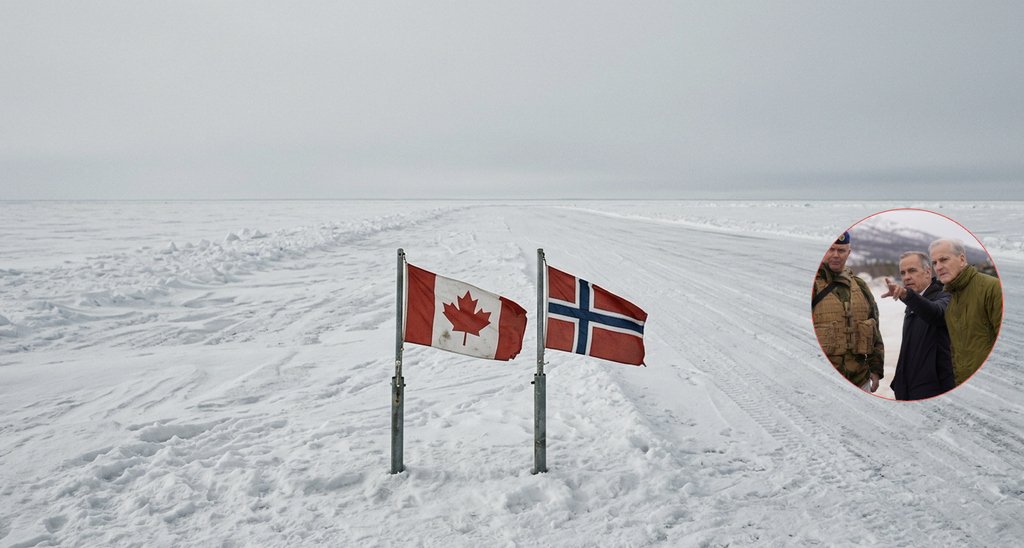
Canada’s turn towards Norway began in March. On the 14th of March, Carney travelled to Oslo for a Canada–Nordic summit and meetings with Norwegian Prime Minister Jonas Gahr Støre. The two governments issued a joint statement covering Arctic security, support for Ukraine, energy, economic security, climate, critical minerals, space and artificial intelligence.
They also signed two agreements. Defence Minister David McGuinty and Norwegian Defence Minister Tore O. Sandvik signed a letter of intent on space cooperation. It sets up a framework for working together on policy, intelligence, research and development, and industry, with a particular focus on Arctic security. Both countries rely heavily on satellites for communications, Earth observation and navigation across their northern territories. A separate memorandum of understanding committed the two countries to closer cooperation on critical minerals.
“Security can no longer be taken for granted,” Carney said in Oslo. Støre said Norway is “stronger when we stand together” with countries like Canada, describing both as “major economies and stable democracies.”
What each side brings is complementary. Norway has some of Europe’s deepest experience in Arctic military operations, and its forces train year-round in the conditions Canada’s North presents. Canada brings geography and, increasingly, ships. It has the world’s second-largest fleet of icebreakers. In August, Carney announced an $11.3 billion contract for six new Polar Class 3 icebreakers for the Canadian Coast Guard, to be built by Davie in Lévis, Quebec. Davie also owns the Helsinki Shipyard in Finland, one of the world’s most experienced builders of polar ships, which ties Canada directly into the Nordic shipbuilding base.
The schedule is long. The first steel for the new icebreakers will be cut in the fall of 2027, and the first ship is due around 2032. Joining a coalition that already operates in the North is one way to fill that gap.
The Money Question
Norway’s other strength is money.
Norges Bank Investment Management runs Norway’s sovereign wealth fund, the largest in the world, worth about $2.3 trillion when Reuters reported its latest proposal in September. It was built from the country’s oil and gas revenues, and it owns a slice of almost every major listed company on earth.
In a letter published in early September, answering questions from Norway’s Finance Ministry, the fund’s leadership recommended a change to how it invests in bonds. “We recommend that the government subindex of the bond index be reduced from 70% to 50%,” wrote central bank governor Ida Wolden Bache and fund chief executive Nicolai Tangen.
US Treasuries are the fund’s largest bond holding, so they would take the biggest cut. By Reuters’ calculations, the fund held about $215 billion of US Treasuries at the end of June. The proposal would reduce that by nearly $80 billion. The US government bond weighting in the fund’s benchmark would fall from 34.1% to 21.9%. In its place, the fund would hold more non-government debt, including mortgage-backed securities, with the US non-government weighting rising from 16.2% to 27.6%.
The limits matter. This is a recommendation, not a decision. The Finance Ministry hasn’t responded, there is no timetable, and any change would be gradual. The fund’s overall exposure to the US dollar would barely move, because most of the money would shift into other American bonds rather than leave the United States. “What changes is the mix inside the dollar market: less U.S. government debt,” a spokesperson said.
But the proposal is on the record, and it comes from the fund’s own managers. It also lands at a moment when other large holders are trimming. The latest US Treasury data show Japan, the biggest foreign holder, cut its Treasury holdings by about $36 billion in August, to their lowest level since December 2024. China cut about $27 billion.
Canada and Norway are not big enough to act alone in the North, militarily or financially. Together, they span most of the North Atlantic and a large share of the Arctic. One has the coastline and the shipyards. The other has the operational experience and one of the largest pools of investment capital in the world.
Canada has formally applied to join the Joint Expeditionary Force. All 10 of its current members are European.
Sources
- Why does Canada want to join the Europe-led JEF military partnership? — Al Jazeera, 18 September 2026
- Canada applies to join UK-led rapid response force — The Defense Post, 21 September 2026
- Should Canada join the Joint Expeditionary Force? — CDA Institute
- Norway and Canada agree on strategic cooperation — Norway News, 15 March 2026
- Canada and Norway deepen space defence ties — SpaceQ, 19 March 2026
- Canada and Norway strengthen defence cooperation in space — Skies Mag
- Norway’s $2 trillion sovereign fund proposes deep cuts to US Treasury holdings — Reuters via KFGO, 4 September 2026
- Norway’s $2.3-trillion sovereign fund proposes large cuts to U.S. Treasury holdings — The Globe and Mail
- PM Carney unveils $11 billion in funding to make 6 icebreakers in Quebec — CP24, 24 August 2026
- Major Foreign Holders of Treasury Securities — US Department of the Treasury