
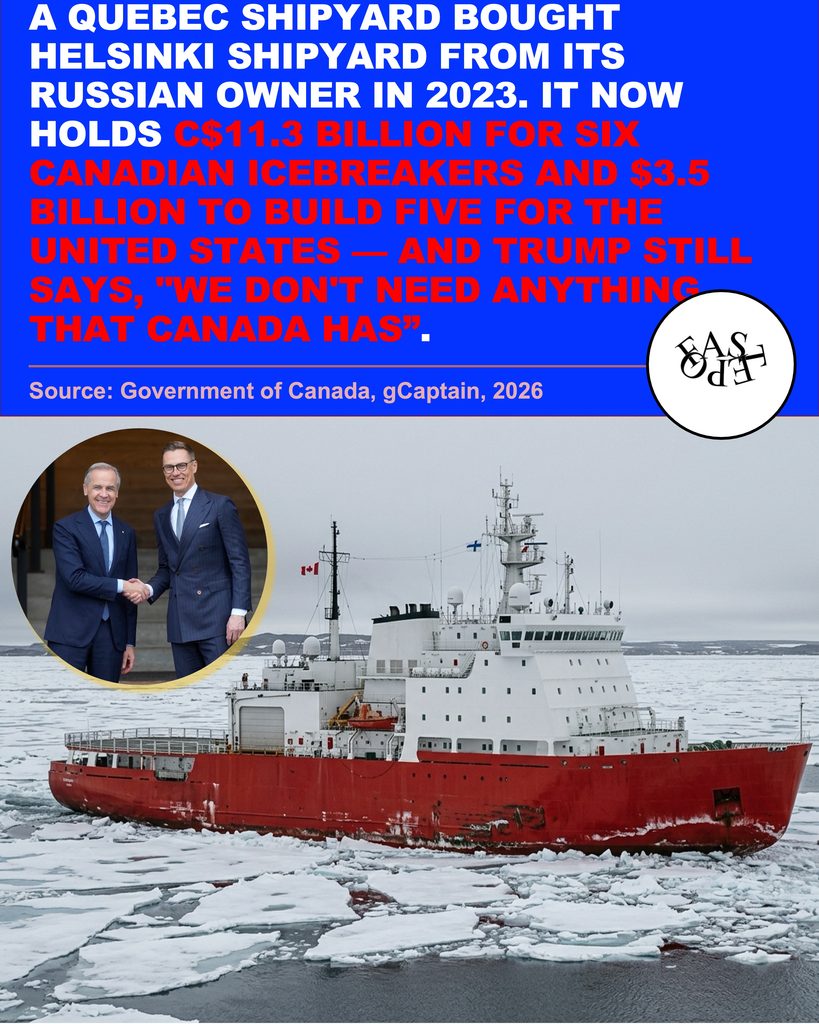
Chantier Davie was excluded from Canada’s National Shipbuilding Strategy for a decade. In 2023 it bought Helsinki Shipyard from its Russian owner. It now holds C$11.3 billion in Canadian contracts and $3.5 billion in American ones.
Three thousand kilometres separate Lévis, Quebec from Helsinki. One company owns shipyards in both, and is currently building a Canadian icebreaker across the Atlantic in pieces, with the hull taking shape in Finland and the superstructure in Quebec.
How that came about explains more about who will actually control Arctic shipping than any statement from Washington.
The outcast
Chantier Davie has been building ships on the St. Lawrence since 1825. It is the oldest shipyard in Canada and, for most of the past fifteen years, it was the one the federal government would not do business with.
When Ottawa established the National Shipbuilding Strategy in 2010, the major work went to Irving in Halifax and Seaspan in Vancouver. Davie was excluded. It spent a decade watching contracts go elsewhere, taking conversion and refit work, and periodically laying off its workforce.
There were reasons. The yard had a troubled financial history and a reputation for delays. Ottawa’s assessment at the time was that it could not be relied upon for complex new-build programmes.
That judgement has not aged well.
Buying Helsinki
In 2023, Davie did something no Canadian shipbuilder had attempted. It purchased Helsinki Shipyard, in Finland, from its Russian owner.
The yard’s significance is hard to overstate. Finland builds a substantial share of the world’s icebreakers, and Helsinki Shipyard has produced most of the complex medium-to-heavy vessels delivered from Finland in the past quarter century. It is, by a considerable distance, the most experienced polar shipbuilder on earth.
It was also, at the time, Russian-owned, having been acquired by a company connected to Russian shipping interests. Finland’s post-2022 position on Russian ownership of strategic industrial assets made a sale both necessary and politically straightforward.
The transaction took roughly $110 million in capital and loans from the Quebec government, and, by Davie’s own account, fourteen Atlantic crossings over ten months.
What Canada bought was not a facility. It was a century of accumulated knowledge about how to build ships that break ice without breaking themselves.
The ICE Pact
The acquisition had a diplomatic consequence that nobody appears to have planned.
After the purchase, Davie’s chairman was invited to speak at the Finnish embassy in Washington on Arctic security and shipbuilding capacity. The conversations that followed contributed directly to the Icebreaker Collaboration Effort, signed by Canada, Finland and the United States in 2024.
The ICE Pact commits the three countries to coordinate icebreaker production, share expertise and build allied capacity against a Russian fleet that dwarfs anything the West currently operates.
A Canadian company buying a Finnish shipyard is why three countries now build together. That is an unusual origin for a trilateral security arrangement.
What is under construction
Polar Max. Officially the CCGS Arpatuuq, named for Akpatok Island. A Polar Class 2 heavy icebreaker, 22,800 tonnes, 138.5 metres long, four Wärtsilä engines producing nearly 40,000 kilowatts, a crew of 100, helipad and hangar. Contract value C$3.25 billion, awarded March 2025.
The construction method is the interesting part. Steel was cut in Helsinki on 20 August 2025. Production began in Lévis on 31 March 2026. Hull assembly started in Helsinki on 28 May. Delivery is scheduled for 2030.
More than fifty Davie employees are currently rotating between the two countries. Canadian workers are in Finland learning from Finnish specialists, so that when the hull crosses the Atlantic the Quebec workforce can complete it, and build subsequent vessels without assistance.
That is the actual product of this arrangement. The ship is the vehicle for the knowledge transfer.
It will be the first polar icebreaker built through collaboration between European and North American yards.
The six Polar Class 3s. On 24 August 2026, Carney announced a C$11.3 billion contract for six Program Icebreakers, all to be built at Lévis. It is the largest shipbuilding contract in Quebec’s history.
Construction begins in 2027, first delivery around 2032, with the full fleet operational by 2038. The government expects nearly 5,000 jobs during construction and roughly C$650 million a year in economic activity. Under Buy Canadian rules the vessels will use Canadian steel and Canadian suppliers.
The Lévis yard is itself undergoing an C$840 million modernisation to handle work of this complexity.
And on the other coast. Seaspan’s Vancouver Shipyards is building the CCGS Imnaryuaq, a second Polar Class 2, for delivery in 2032. Seaspan is also in line for up to sixteen multi-purpose icebreakers under a separate C$14.2 billion programme.
Two heavy polar icebreakers under construction simultaneously, on opposite coasts, is something Canada has not done in living memory.
The fleet comparison
Russia operates the largest icebreaker fleet in the world, including nuclear-powered vessels, and has done for decades. Canada has the second largest. The United States operates a handful, and its replacement programmes have slipped repeatedly across multiple administrations.
Canada has the longest coastline of any country on earth. Most of it is Arctic.
That gap between American ambition and American capacity is the reason for what happened in May.
Building America’s ships
Davie Defense, the company’s American subsidiary, finalised a $3.5 billion contract for five Arctic Security Cutters for the United States Coast Guard.
The first two will be built at Helsinki Shipyard. The remaining three at Gulf Copper facilities in Galveston and Port Arthur, Texas, where Davie plans to invest up to $1 billion in what it describes as an American Icebreaker Factory.
The full American programme is eleven cutters, with the first expected in 2028: four built in Finland, seven in the United States.
Davie’s parent group, Inocea, now operates five major shipyard facilities across Canada, the United States and Finland.
So a country whose president has said repeatedly that it does not need anything Canada has is having a substantial portion of its new Arctic fleet built by a Canadian-owned company, using a Finnish yard that company purchased from Russia.
What this does not prove
Three qualifications, and they are not small.
Nothing is in the water. Polar Max delivers in 2030. The six Polar Class 3 vessels arrive between 2032 and 2038. The American cutters begin in 2028. Every figure in this piece describes steel, contracts and intentions rather than operational ships, and large shipbuilding programmes have a long history of slipping.
Davie’s record was genuinely poor. Ottawa’s decision to exclude it from the National Shipbuilding Strategy was not arbitrary. The company’s performance before 2023 is the reason it spent a decade outside the programme, and the current contracts are a bet that the Helsinki acquisition has changed what it is capable of. That bet has not yet been settled.
And Russia remains far ahead. Second place is still second place. Nothing the West fields this decade will approach the Russian fleet in size or in nuclear capability. The gap is being narrowed, not closed.
What it does show
For most of the past century, Canadian industrial policy on shipbuilding consisted of protecting a small domestic industry that could not compete internationally, while buying complex vessels from abroad when it mattered.
What Davie did was the opposite. It bought the expertise rather than the ships, brought it inside a Canadian-owned corporate structure, and is now selling that capability back into the American and Finnish markets.
The Arctic argument of the past two years has been conducted in the language of ownership: who should control Greenland, whose flag flies where, which country is capable of securing the north. The assumption underneath it is that capability follows from sovereignty.
The shipbuilding suggests the reverse. Capability is a thing you acquire, staff and finance, and at the moment a company headquartered in Lévis has more of it than the country that has been loudest about needing it.
Sources
- Canada Bets $11 Billion on Six New Icebreakers as Arctic Shipbuilding Race Accelerates, gCaptain
- Davie Adds Six Canadian Icebreakers to Growing Arctic Shipbuilding Portfolio, gCaptain
- Building an Arctic icebreaker: ‘Polar Max’ takes shape in Helsinki shipyard, ArcticToday
- Canada Awards Historic $8B Deal for Six Polar Class 3 Icebreakers, The Defense Post
- CCGS Arpatuuq, Wikipedia