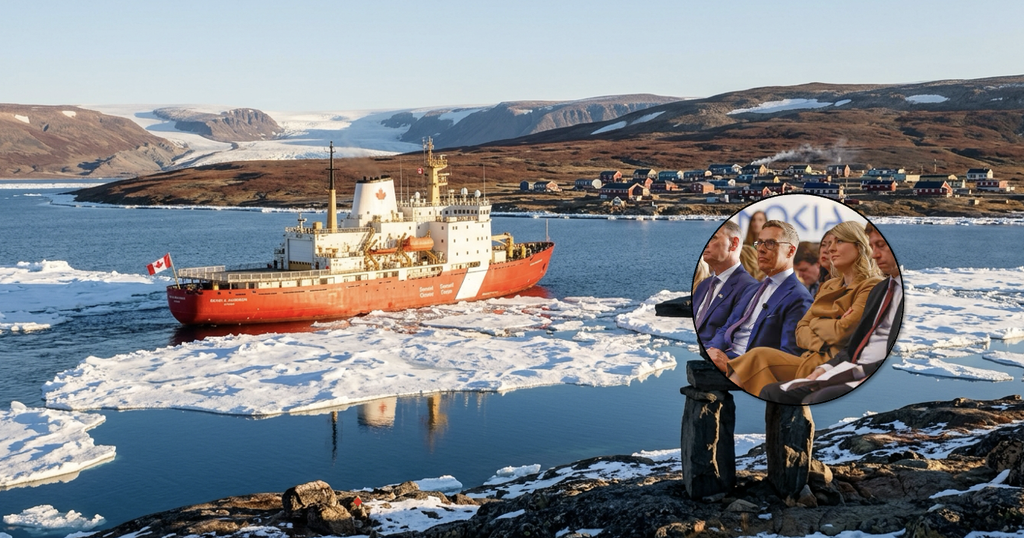
An Inuit-led company brought a Finnish Polar Class 3 icebreaker into Canadian service this season. It fills the gap while Ottawa’s $11.3 billion fleet is built in Lévis, and it fits a pattern of Indigenous ownership spreading across Canada’s North.
On the 4th of September, a Polar Class icebreaker sailed into St. John’s harbour from Finland, fully crewed and bound for the Arctic.
The MSV Nordica didn’t arrive as a government purchase or a foreign deployment. It was brought in by Qikiqtaaluk Horizon Arctic Services, an Inuit-led joint venture between Qikiqtaaluk Corporation and St. John’s-based Horizon Naval Engineering. It will supply heavy icebreaking directly to the Canadian Coast Guard this season, working alongside federal ships.
It’s the first arrangement of its kind between an Inuit-led company and the Coast Guard. The partnership isn’t consulting or collecting benefits. It is delivering the capability itself.
“This partnership with the Canadian Coast Guard demonstrates what is possible when Inuit leadership” comes together with industry expertise and Canadian capability, said Harry Flaherty, president and CEO of Qikiqtaaluk Corporation.
Sean Leet, president of Horizon Naval Engineering, was more direct: “The arrival of Nordica in Canadian waters is what doing the work looks like.” It isn’t an announcement about something that’s just getting started, he said, because Canada has a window of opportunity in the Arctic.
The Ship, and the Gap It Fills
The details:
- Ship: MSV Nordica, a Polar Class 3 icebreaker chartered from Finland
- How: chartered through a procurement led by Public Services and Procurement Canada
- Role: extra icebreaking capacity, safe navigation and Arctic shipping, plus support for maritime awareness, emergency response and northern operations
- Season: the Coast Guard contract runs through November
- Crew: up to 30 Indigenous cadets per shift, each about 28 days long, from communities in Newfoundland and Labrador and across Canada
Leet says the cadet time is real career progress: “This is practical sea time that counts toward them being able to advance their career in the marine industry,” on the path from second mate to chief mate and eventually captain.
The gap the Nordica fills is a long one.
On the 24th of August, at Chantier Davie in Lévis, Quebec, Prime Minister Mark Carney announced an $11.3 billion contract for six new Polar Class 3 icebreakers for the Coast Guard, the largest shipbuilding contract in Quebec’s history. Each ship will be about 110 to 120 metres long, able to hold three knots through 1.4 metres of ice, carry a medium helicopter and sail about 20,000 nautical miles without refuelling.
The program will:
- Support about 5,000 jobs during construction
- Use Canadian steel under Buy Canadian rules, from suppliers including Algoma Steel
- Draw on more than 1,500 suppliers
The schedule is long. “The first steel will be cut next fall,” Carney said, meaning fall 2027, and “the first ship will be delivered five years later.” That puts the first ship around 2032 and the full fleet around 2038. The program was first announced in 2019, with deliveries originally promised by 2027.
The Nordica’s country of origin matters too. Finland designs and builds more icebreakers than any other country. Canada, Finland and the United States are partners in the ICE Pact, and Davie is also part of the emerging American icebreaker supply chain.
Carney described the partnership as a “reminder of one of the many, many, many things that the United States needs from Canada.”
The United States has three working polar icebreakers: the heavy Polar Star and the medium Healy and Storis. Trump has repeatedly said America should control Greenland.
Who Owns the North
The Nordica is part of a much larger northern build-out. In March, Carney announced more than $40 billion for the Arctic, including:
- $32 billion for forward operating locations in Yellowknife, Inuvik and Iqaluit
- $6.5 billion for an Arctic over-the-horizon radar system built with Australia
The more striking pattern is who owns the infrastructure:
- Port of Churchill and the Hudson Bay Railway: owned by 29 First Nations and 12 northern communities
- Darlington New Nuclear Project, Canada’s first small modular reactor: seven Ontario First Nations (Alderville, Curve Lake, Hiawatha, Mississaugas of Scugog Island, Beausoleil, Chippewas of Georgina Island and Chippewas of Rama) put in $700 million in June
- Arctic icebreaking: an Inuit-led company now supplies a Polar Class 3 icebreaker to the Coast Guard
Arctic sovereignty has usually been debated in Ottawa and Washington. This season, an Inuit-led company is supplying the icebreaker.
Sources
- Polar Class icebreaker MSV Nordica arrives in Canada to strengthen Coast Guard Arctic capability — Newswire, 4 September 2026
- MSV Nordica heads north with Indigenous cadets aboard — VOCM, 5 September 2026
- Finnish icebreaker supports Canadian Coast Guard in the Arctic — The Maritime Executive
- Inuit-led partnership delivers polar icebreaker to Canadian Arctic — Canadian Defence Review
- PM Carney unveils $11 billion in funding to make 6 icebreakers in Quebec — CP24, 24 August 2026
- Canada bets $11 billion on six new icebreakers as Arctic shipbuilding race accelerates — gCaptain, 24 August 2026
- First Nations equity partnership to build the G7’s first small modular reactors — ReNew Canada, 24 June 2026