In 1964, Canada sold almost no cars to Americans. Ten years later, most of what it built went south. The agreement behind that was signed at Lyndon Johnson’s ranch in Texas, to stop a trade war.
“The only reason Canada makes Autos is because of previous disastrous Trade Agreements while other Presidents were in Office.”
Donald Trump posted that on Truth Social in early September, weeks after announcing that the US tariff on Canadian cars and auto parts will rise to 50% on the first of January.
There was an agreement. Before it, in 1964, Canadian-built cars made up less than 1% of American sales. A decade later, 59% of every vehicle built in Canada was heading south.
So how did a car industry built to keep American cars out become one of America’s biggest suppliers?
It started with a tariff wall. In 1904, Ford opened in Walkerville, Ontario, to build behind it. By the end of the 1920s, Canada had the second-largest auto industry in the world. But it built for Canada and the British Empire, not for the United States. When the Depression hit, exports collapsed from 102,000 vehicles to 13,000.
After the Second World War, the problem was size. The American companies in Canada built dozens of models in production runs too short to be efficient:
- Productivity was only 60 to 65% of the American level
- Canadians paid more and had less choice
- By 1964, Canada’s auto trade deficit with the United States had reached US$600 million
In 1960, Prime Minister John Diefenbaker asked the economist Vincent Bladen to find a fix. In 1962, Ottawa tried one: automakers could earn back the duty on imported parts by exporting Canadian-made parts. A year later, Lester Pearson’s government extended the scheme to whole vehicles.
American parts makers called it a subsidy and asked Washington to strike back. A trade war over cars was coming.
The Deal That Built It
Instead, the two governments sat down.
On the 16th of January, 1965, Pearson and Lyndon Johnson signed the Automotive Products Agreement at Johnson’s ranch in Texas. Johnson said they had faced a choice between “the road of stroke and counterstroke and the road of understanding and co-operation.”
The Auto Pact had three parts:
- Duty-free trade. Cars, trucks and original parts crossed the border without tariffs, for the companies that built in Canada.
- Safeguards. For every car a company sold in Canada, it had to build one there, and keep Canadian content at least at its 1964 level.
- Investment. The companies pledged US$260 million of new investment in Canada.
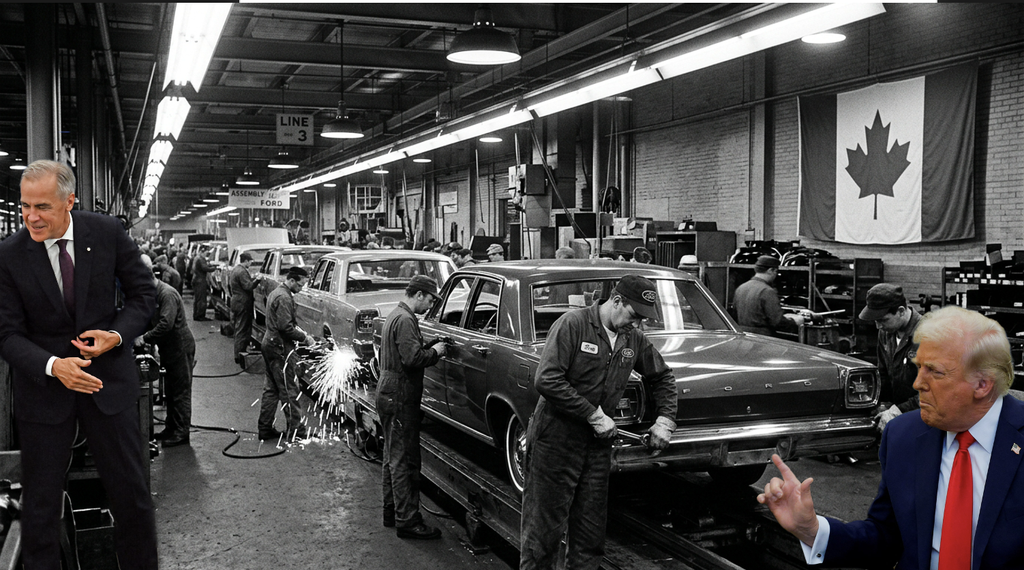
That changed how the plants worked. A factory in Oakville or Oshawa no longer had to build every model for a small market. It could build one or two models for the whole continent.
The results:
- Canadian vehicle exports to the US: 48,000 in 1965, 849,000 in 1975
- Trade balance: the deficit became a small surplus by 1970
- Canadian value added: five times its 1964 level by 1977
Johnson reportedly told a Canadian diplomat in private: “You screwed us on the Auto Pact.”
But trade flowed both ways. American vehicle exports to Canada rose from 64,000 in 1965 to 698,000 by 1975.
Then the Japanese automakers arrived:
- Honda in Alliston, Ontario, in 1986
- Toyota in Cambridge, Ontario, in 1988
- Canada–US free trade in 1989
In 1999, Canada built a record 3.1 million vehicles. Auto jobs had risen from about 80,000 in 1965 to 185,000. In 2004, Ontario out-produced Michigan.
The Deal That Ended
The Auto Pact was never free trade. It was managed trade, and Washington never liked the safeguards. In 1971, the Nixon administration came close to cancelling it.
In the end, it wasn’t Washington that ended it. Japan and the European Union challenged the safeguards at the World Trade Organization and won. Canada ended the pact on the 19th of February, 2001.
Production has fallen since:
- 1999: 3.1 million vehicles
- Last year: about 1.2 million
- More than three quarters of that came from Toyota and Honda
- Roughly 90% of what Canada builds still goes to the United States
The pact made Canada a major producer. It also tied the industry to one customer.
Now that customer is raising the price. On the 1st of January, 2027, the US tariff on Canadian cars doubles to 50%, and auto parts, which had been exempt, face 50% too. Announcing it, Trump wrote: “Build in the U.S. and there are ZERO TARIFFS. Canada will be treated like a State no longer!”
The agreement Trump calls disastrous was signed by an American president, at his own ranch, to stop a trade war. In the ten years that followed, American vehicle exports to Canada rose more than tenfold.
Source: The Canadian Encyclopedia; Government of Canada; Al Jazeera; Truth Social
Sources
- Auto Pact — The Canadian Encyclopedia
- Canada–United States Automotive Products Agreement — Wikipedia
- Trump blames Biden for his own Canada trade deal (Truth Social post) — Joe.My.God., 9 September 2026
- Trump slams Canada with new 50 percent auto tariffs from January — Al Jazeera, 24 August 2026
- Trump says U.S. will hike Canada auto tariffs to 50% — CNBC, 24 August 2026