
On Tuesday, LNG Canada approved a C$32 billion expansion with a Korean state partner. On Wednesday, Trump announced a $54 billion Korean investment in Alaska. On Thursday, Seoul said it had decided nothing. On Friday, the threats began.
“If they don’t want to do it, that’s OK with me. I’ll just charge them more.”
That was Donald Trump on Friday, the second of October, asked about South Korea’s response to the gas project he had announced two days earlier.
Then he went further:
“Tell them if they don’t sign shortly, I’m going to double it up.”
Asked whether he had announced the deal before Seoul agreed to it, he said: “I didn’t jump the gun. I mean, they were there.”
Here is what happened that week, in order.
Four Days
Tuesday, 29 September. In Kitimat, British Columbia, the partners in LNG Canada took a final investment decision on Phase 2 of the terminal, about C$32 billion of private investment that doubles its capacity from 14 to 28 million tonnes a year. One of the five partners signing off was KOGAS, Korea Gas Corporation, South Korea’s state-owned gas company, which holds 5 per cent.
Wednesday, 30 September. In the Oval Office, Trump announced a $54 billion plan for an LNG export project in Alaska, presented as the centrepiece of South Korea’s commitment to invest in the United States. According to Bloomberg, no member of the South Korean government attended. A representative of Glenfarne Group, the privately held developer of the Alaska project, did.
Thursday, 1 October. Seoul responded. The Industry Ministry said: “No decision has been made on whether to invest or on the size of the investment.” Speaking at the Armed Forces Day ceremony the same day, President Lee Jae-myung said of the Alaska project and the American nuclear plants also on Trump’s list: “Commercial viability must be guaranteed on a specific plant-by-plant basis.”
Friday, 2 October. “I’ll just charge them more.”
What Korea Has Actually Committed
South Korea’s investment pledge to the United States, made under last year’s trade agreement, totals $350 billion: $200 billion for strategic investment and $150 billion for shipbuilding.
Trump’s list of first projects under that pledge included three items:
- Eight nuclear power plants, about $120 billion
- A gas-fired power plant in Texas for AI data centres, $22.3 billion, about 6 gigawatts
- The Alaska LNG project, $54 billion
Seoul has confirmed the Texas plant. The nuclear plants and the Alaska project, it says, remain under review.
Lee also set out the terms: profits from every project are to be split 50-50 until Korea’s principal and interest have been recovered.
The Alaska Project, by the Numbers
Alaska LNG would carry gas from the oil fields of the North Slope through an 800-mile pipeline to an export terminal at Nikiski, on Cook Inlet, south of Anchorage.
Glenfarne, which holds 75 per cent of the project alongside the state-owned Alaska Gasline Development Corporation, released its cost estimate in June:
- Pipeline: $13.2 to $16.9 billion
- Gas treatment plant on the North Slope: $7.7 to $9.2 billion
- Liquefaction and export terminal: $23.6 to $28.4 billion
- Total: $44.5 to $54.5 billion
Planned capacity is 20 million tonnes a year, with first exports targeted for 2031.
That works out to $2.2 to $2.7 billion per million tonnes of annual capacity. On the US Gulf Coast, comparable projects cost around $1 billion per million tonnes or less. Cheniere’s Corpus Christi Stage 3 came in at about $760 million, Venture Global’s Plaquemines at about $1.05 billion.
Alex Munton of Rapidan Energy Group says the project “may not be able to meet commercial thresholds for investment.” Jason Feer of Poten & Partners puts the question this way: “whether Asian buyers will pay premium for supply security. Evidence lacking so far.”
Glenfarne has preliminary agreements covering about 13 million tonnes a year but needs binding contracts for at least 16 million. Korean steelmaker POSCO’s trading arm has signed a framework agreement for 1 million tonnes a year over twenty years.
The project is not new. ExxonMobil, BP and ConocoPhillips developed it together in the mid-2010s and withdrew in 2016. Alaska state officials said at the time that the producers had found it “too expensive to compete in an oversupplied global LNG market.”
Can He Double It?
On 20 February 2026, in Learning Resources v. Trump, the Supreme Court ruled that the president cannot impose tariffs under the International Emergency Economic Powers Act, the emergency law behind most of the country-by-country tariffs of his second term.
Bloomberg reports that it is unclear whether Trump has the power to raise levies on South Korean goods unilaterally as retaliation.
Why Alaska, Why Now
Alaska has a competitive Senate race in November’s midterm elections. Bloomberg describes the project as politically important for Trump and Republicans.
In a separate development the same week, Trump appeared on a campaign trip alongside Dennis Rodman, who has travelled to North Korea several times, as the president continues to seek an in-person meeting with Kim Jong Un. North Korea has so far rebuffed the offer. Bloomberg identifies this as another possible point of friction with Seoul.
Meanwhile, in Kitimat
LNG Canada began shipping in mid-2025. Its first cargo left Kitimat for Asia at the end of June that year.
The Phase 2 decision adds two more liquefaction trains, storage, a second loading berth and five new compressor stations on the 670-kilometre Coastal GasLink pipeline, which already carries gas from northeastern British Columbia to the coast. Start-up is expected in the early 2030s.
The ownership:
- Shell: 40 per cent
- PETRONAS (Malaysia): 25 per cent
- PetroChina: 15 per cent
- Mitsubishi Corporation (Japan): 15 per cent
- KOGAS (South Korea): 5 per cent
KOGAS has been a partner since the project’s original investment decision in 2018.
Ottawa called Phase 2 the second-largest single private investment in Canadian history. Prime Minister Mark Carney said: “Twelve months from referral to final investment decision is the pace that this pivotal moment in Canada’s history demands.”
The Pacific Advantage
Both Kitimat and Nikiski sit on the Pacific. That matters for the buyers both projects are chasing.
According to RBN Energy, LNG from Western Canada reaches Asia in about 11 days, at a shipping cost under $1 per MMBtu. From the US Gulf Coast, the trip takes about 24 days through the Panama Canal at about $2, 35 days through Suez at $2.80, or 40 days around the Cape of Good Hope at $3.
Jack Weixel of East Daley Analytics, assessing Alaska’s strategic advantages, noted that Canadian competitors may prove the stronger option.
Side by Side
Alaska LNG. Proposed. Not built. $44.5 to $54.5 billion. 20 million tonnes a year planned. First exports targeted for 2031. Binding contracts still needed for at least 16 million tonnes. Korea’s government: “No decision has been made.”
LNG Canada. Shipping since 2025. 14 million tonnes a year today, 28 after Phase 2. Phase 2 approved 29 September 2026, about C$32 billion. Korea’s state gas company: a signed partner, 5 per cent.
The Oval Office announcement came on Wednesday. LNG Canada’s decision came on Tuesday.
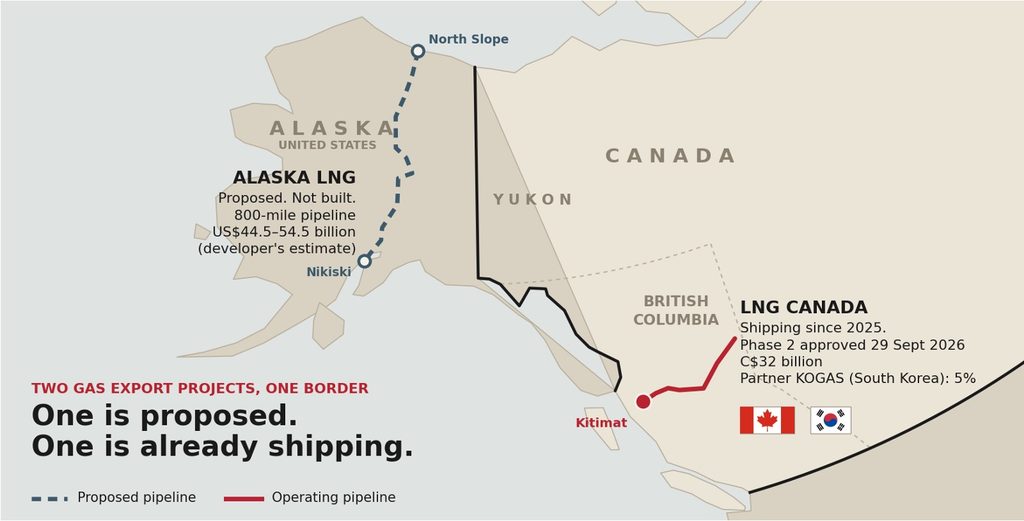
Source: Bloomberg; Korea Times; EnergyNow; BNN Bloomberg
Sources
- Trump threatens to ‘charge’ Korea ‘more’ if it rejects Alaska LNG project — Korea Times, 3 October 2026
- Trump threatens South Korea over Alaska LNG project dispute — Bloomberg via Japan Times, 3 October 2026
- Korea Disputes Trump’s Claim It Agreed to Invest in Alaska LNG — Bloomberg via Energy Connects
- Lee Ties Alaska LNG Talks to Proof of Commercial Viability — Seoul Economic Daily, 1 October 2026
- South Korea’s $200B US Investment Plan Leaves Alaska LNG Uncertain — MarineLink, 1 October 2026
- Trump-backed Alaska LNG revival still faces viability questions in Korea — Korea Times, 1 October 2026
- Alaska LNG Could Cost More Than Double Gulf Coast Rivals — EnergyNow, 2 October 2026
- Glenfarne releases Alaska LNG cost estimates — Alaska Public Media, 4 June 2026
- LNG Canada to go ahead with Phase 2 in Kitimat — BNN Bloomberg, 29 September 2026
- LNG Canada takes FID on Phase 2 expansion to reach 28 Mt/year — Enerdata
- Prime Minister Carney welcomes LNG Canada Phase 2 — BOE Report, 29 September 2026
- Tanker bound for Asia after loading Canada’s first cargoes of LNG — CBC
- LNG Canada Has Edge on Deliveries to Asia — RBN Energy
- Supreme Court Strikes Down IEEPA Tariffs — WilmerHale, 20 February 2026