The United States imports nine of every ten tons of its potash from Canada and exempted it from its own tariffs. BHP’s Jansen mine could supply a tenth of the world.
Xi Jinping arrived in Washington on Tuesday. The summit at the White House is today, and critical minerals sit near the top of the agenda.
The reason is not complicated. China holds a near-monopoly on refining the minerals that go into weapons systems, semiconductors, batteries and almost every advanced technology. The trade truce suspending Beijing’s export controls expires on November 10, and American officials have said the flow of Chinese rare-earth magnets has been insufficient.
So the President of the United States spent this week negotiating with China for access to minerals.
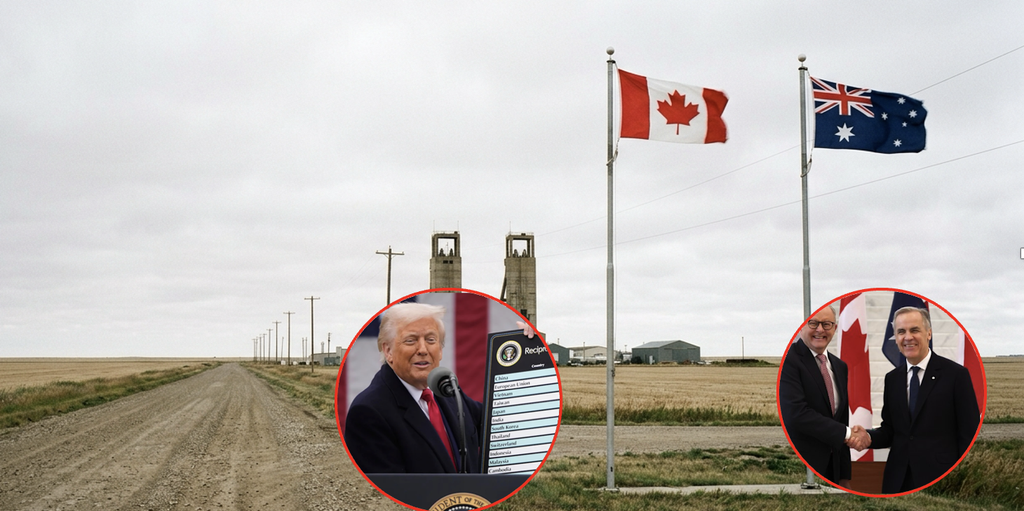
Meanwhile, 140 kilometres east of Saskatoon, two concrete towers rise out of wheat stubble. They are the shaft headframes of a mine producing a mineral that is also on America’s critical minerals list, which America already buys almost entirely from Canada, and which its own government exempted from its own tariffs because there was no alternative.
A sea that dried up
Roughly 400 million years ago an inland sea covered what is now central Saskatchewan. It evaporated, leaving behind the Prairie Evaporite Deposit, a band of mineral salts buried about a kilometre underground. It is the largest known potash deposit in the world.
Potash is potassium, the K in the three numbers on every bag of fertiliser. There is no substitute. Corn, soybeans, wheat and canola all need it, and a shortage does not appear at the grocery till straight away. It appears a season later, as smaller harvests, and then in food prices.
Saskatchewan holds roughly 1.1 billion tonnes of recoverable potassium oxide equivalent. Russia holds about 920 million, Belarus about 750 million. Nowhere else is close. Canada supplied almost a third of global production in 2024, and every one of the country’s ten active potash mines sits in a single province.
What BHP is building
Jansen is the largest single investment in Saskatchewan’s history, and the largest in BHP’s own 140-year history. Total approved investment is C$21.8 billion, about US$15.3 billion.
Stage one is designed for roughly 4.15 million tonnes of potash a year. It is about 84 per cent complete, with first production expected in mid-2027.
Stage two adds another 4.36 million tonnes annually. It is about 16 per cent complete and now expected in late 2031.
Together, around 8.5 million tonnes a year. BHP’s own estimate is that Jansen could account for up to ten per cent of global potash production. The expected mine life runs to nearly sixty years, and once fully operating BHP expects the lowest unit costs of any potash producer in Canada, with operating margins around 63 to 64 per cent.
BHP is Australian, headquartered in Melbourne. Prices in its planning are quoted free on board Vancouver, meaning shipped off the Pacific coast, and the output will go wherever the buyers are.
The dependency Washington already conceded
The United States imports more than 90 per cent of the potash its farmers use. Between April 2025 and March 2026 it imported about 8.7 million tons of potassium fertiliser, and according to the USDA’s own data, nearly nine of every ten tons came from Canada.
There is no domestic deposit waiting to be opened. After Canada, the largest producers are Russia and Belarus. China mines potash but consumes far more than it produces and is itself a major importer, which makes it a competitor for Canadian supply rather than an alternative to it.
That arithmetic explains two decisions.
In March 2025, potash was reinstated to the American critical minerals list by executive order, reversing a removal made in 2022.
Then in July, when the Section 338 tariffs were issued, potash was written out of them, along with energy and critical minerals, while Canadian alcohol, motorcycles and dairy were banned outright. Chuck Grassley, the Republican senator from Iowa, had publicly asked for the exemption, because Iowa’s corn cannot be grown without Canadian potash and there is nowhere else to buy it.
A government choosing which imports to tax is also publishing a list of the ones it cannot do without.
The Belarus experiment
The dependency was tested in public this week, and it lasted about thirty hours.
On Monday, Trump posted that the United States was working on a massive deal to buy potash from Belarus at pricing substantially below what it pays Canada, calling it very good news for American farmers.
The same day, Alexander Lukashenko’s office published his remarks: even if Belarus wanted to supply Western markets, it does not have those volumes, because everything is contracted for the year. Belarus has redirected its exports eastward.
Scott Moe, the premier of Saskatchewan, responded that evening. “Buying blood potash from Belarus is supporting Russian aggression. It’s wrong and it doesn’t make sense.” He pointed out that more than 40 countries still maintain sanctions on Belarus for supporting the invasion of Ukraine, and asked whether anyone believed Belarusian potash shipped through Russia would be more affordable, sustainable or ethical than potash from Saskatchewan.
There was a practical problem too. Lithuania, a NATO and EU member, closed its Baltic port to Belarusian potash in 2022 and has said it will not be pressured into reopening it. The only remaining route runs through Russia.
On Tuesday, at the United Nations General Assembly in New York, in a bilateral meeting with Volodymyr Zelenskyy, Trump was asked about the deal.
“Belarus has a lot of potash, and our farmers need good prices, and we want to get a lower price. We’ll continue to go with Canada, but Belarus would like to sell it for a much lower price.”
Moe’s assessment afterwards was that the plan had never been realistic.
Why an Australian company
There is something worth pausing on in who is building this.
The trade dispute of the past eighteen months has been conducted almost entirely between Ottawa and Washington. But the single largest addition to North American fertiliser capacity in a generation is being financed from Melbourne.
Australia and Canada have more in common than most people notice. Both are resource economies. Both are Commonwealth members, both sit inside Five Eyes, and since September both have been inside the same Pacific trade bloc. Canadian direct investment in Australia stands at $58.8 billion, the largest in the Asia-Pacific. Australia’s trade minister said this month that his country is “on the same page” as Canada as it deepens ties with Europe.
Jansen runs the other way: Australian capital, Canadian ground, and a global customer base that includes the United States without being limited to it.
The honest parts
Three of them, and none is small.
The cost has ballooned. Stage one was approved in August 2021 at US$5.7 billion. It now stands at US$8.4 billion, a 47 per cent increase driven by inflation, design and scope changes, and lower productivity. Stage two has risen 40 per cent, from US$4.9 billion to US$6.9 billion, and slipped two years from 2029 to 2031. BHP puts the payback period for stage one at 11 to 15 years from first production.
The benefit to Saskatchewan is contested. Erin Weir, a former MP writing for the province’s own school of public policy, points to K+S’s Bethune mine, which opened nearby and paid the Saskatchewan government roughly a quarter of a billion Canadian dollars in its first eight years. His conclusion is blunt: claims that Jansen will generate tens of billions in taxes and royalties should be treated with caution.
And more supply means lower prices. Adding capacity equal to a tenth of world production will push potash prices down. That helps farmers everywhere, including in Iowa. It hurts the royalty income Saskatchewan is counting on. The province’s own budget assumes a smooth phase-in with rising prices, which Weir describes as a scenario unlikely to hold.
It is also worth being clear that Jansen is not a response to any of this. It was approved in 2021, years before the trade dispute began. The timing is a coincidence rather than a strategy.
What it adds up to
Today, the United States is asking China for minerals it cannot obtain elsewhere, with a deadline of November 10 hanging over the conversation.
The one critical mineral it can obtain elsewhere comes almost entirely from one Canadian province. Washington acknowledged that in writing twice this year: once by putting potash back on its critical minerals list, and once by exempting it from tariffs it applied to almost everything else Canada sells.
It tested the alternative this week. The alternative said it had nothing to sell, and the plan lasted a day and a half.
Meanwhile the concrete keeps going down east of Saskatoon, financed from Melbourne, shipping from Vancouver, on a mine designed to run for sixty years.
Sources
- BHP says first phase of Jansen potash mine to now cost $8.4-billion, The Globe and Mail
- Jansen, BHP
- Sask. premier unsurprised that Trump now says U.S. will continue with Canadian potash, CBC News
- Xi-Trump Summit Agenda: AI, Tariffs, Critical Minerals, Bloomberg
- Saskatchewan Potash at a Crossroads, Johnson Shoyama Graduate School of Public Policy