There is no large coal export terminal anywhere on the United States West Coast. Cherry Point was blocked. Longview was blocked. Oakland was blocked. Nine projects were cancelled. The coal that reaches the Pacific leaves through a Canadian port.
On 26 September, the White House announced that China had agreed to import at least 10 million metric tonnes of American coal in 2027, and at least 10 million metric tonnes again in 2028.
Twenty million tonnes over two years. The commitment came out of a three-day meeting between Donald Trump and Xi Jinping, and it will be administered through the newly operational US-China Board of Trade.
It was not the only item. The two sides agreed to preferential tariff treatment on roughly $30 billion of non-sensitive goods. On the American side: agricultural products, seafood, timber, cosmetics and medical devices. On the Chinese side: small appliances, toys, holiday decorations and children’s car seats. A new agricultural working group was established.
The coal number carries a logistical problem that the announcement did not address.
What the deal restarts
This is not an expansion of an existing trade. It is the revival of one that stopped completely.
In February 2025, China imposed an additional 15 per cent tariff on American coal. In April 2025, it added a 34 per cent reciprocal tariff, and from that month it stopped taking American coal altogether.
The effect on the American industry was measurable within a year. US coal exports fell to 93 million short tons in 2025, down from 108 million short tons in 2024 — a drop of 15 million tons after four consecutive years of growth. Thermal coal exports fell 18 per cent. Metallurgical coal exports fell 11 per cent.
The Energy Information Administration attributed the decline largely to a single cause: a 92 per cent decrease in exports to China.
China takes roughly one-tenth of American coal exports in a normal year. Its withdrawal was enough to reverse the trend line for the whole sector.
There is no large coal export terminal on the United States West Coast
Three were proposed in the last fifteen years at the scale that would have mattered. All three were stopped.
Gateway Pacific Terminal, Cherry Point, Washington. Designed to move 48 million tonnes a year, which would have made it the largest coal export facility in North America. In May 2016 the US Army Corps of Engineers denied the permit, finding the project would impair the Lummi Nation’s treaty-protected fishing rights. It was formally withdrawn in February 2017.
Millennium Bulk Terminals, Longview, Washington. Designed for 44 million tonnes a year. Washington State denied the water quality permit in 2017. After four years of litigation the project was cancelled in 2021.
Oakland Bulk and Oversized Terminal, California. Blocked by a 2016 City of Oakland ordinance prohibiting the handling and storage of coal at the facility.
They were not isolated failures. Nine proposed coal export facilities in the Pacific Northwest have been cancelled since 2010, representing at least 133 million tonnes of annual coal-handling capacity that was planned and never built. Among them: Port Westward at St. Helens, Oregon, at 22 million tonnes; Coyote Island at Morrow, Oregon, at 8 million tonnes.
Two small California facilities still handle coal — the Port of Stockton, at roughly 2 million tonnes a year, and the Levin-Richmond Terminal, at roughly 1 million. Richmond’s city council voted to ban coal in 2020, and under a subsequent legal settlement the terminal’s coal handling is being wound up by 2026–27.
Three million tonnes of combined capacity, one of which is closing, against a commitment of twenty million tonnes.
What exists instead is in British Columbia
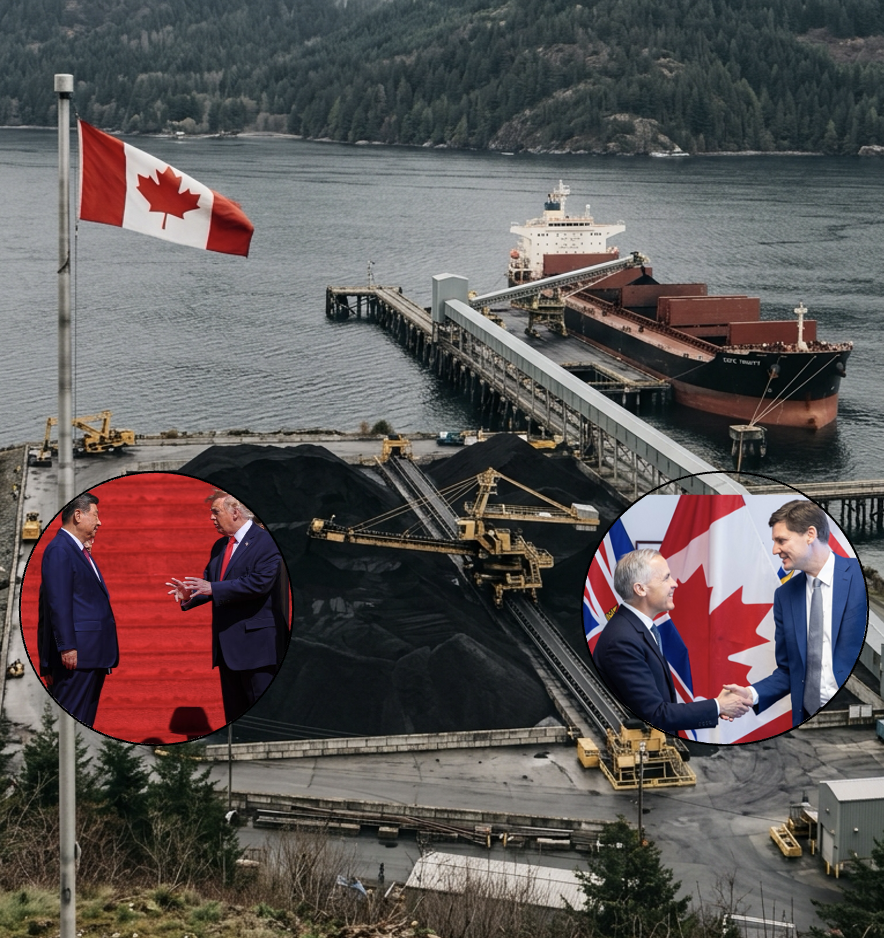
Westshore Terminals, at Roberts Bank 32 kilometres south of Vancouver, is Canada’s principal coal export facility and one of the largest in North America. After a $270 million reinvestment programme completed in 2019, its rated capacity is 36 million tonnes a year.
It handled 23.6 million tonnes in its 2025 financial year, down from 26.8 million the year before, partly because a fire on the Berth 1 shiploader in August 2025 forced it to cut guidance.
A substantial share of what it loads is American. Westshore takes thermal coal from the Powder River Basin in Montana and Wyoming, and from Utah — coal that is physically closer to the Pacific than to the Atlantic and has no American port to leave from. Reporting on last year’s volumes put American thermal coal moving through the terminal at 14.8 million tonnes.
Its largest Canadian customer, Teck Resources, cut its contracted volume to 5 to 7 million tonnes a year under a 2020 renegotiation.
Further north, Trigon Pacific Terminals at Prince Rupert moved 10.4 million tonnes in 2025, a 14 per cent increase and 40 per cent of everything exported through that port. It handles Canadian steelmaking coal, thermal coal and petroleum coke, shipping principally to Japan and South Korea, with additional cargoes to China, India and Europe.
Premier David Eby has described the arrangement in one sentence: “the Americans cannot get it out through any of their own ports, and they will not ship it themselves.”
Two kinds of coal, two different maps
The White House announcement did not specify what kind of coal China has agreed to buy. The distinction determines the route entirely.
Metallurgical coal makes steel. In 2023, American met coal production broke down by state as follows: West Virginia 46 per cent, Alabama 12 per cent, Virginia 8 per cent, Pennsylvania 8 per cent, Kentucky 3 per cent, Maryland 1 per cent, Colorado under 1 per cent. Almost three-quarters of it is mined in Appalachia.
Wyoming, the largest coal-producing state in the country, produces no metallurgical coal at all.
That coal leaves through the Atlantic and the Gulf. Over the past five years, East Coast ports — Norfolk, Virginia and Baltimore, Maryland — handled 62 per cent of all American coal exports. Gulf Coast ports at Mobile and New Orleans handled 25 per cent. The West Coast accounted for 8 per cent.
The Lambert Point Coal Terminal at Norfolk alone accounts for roughly 58 per cent of all American metallurgical coal exports.
Thermal coal is burned for electricity. It comes overwhelmingly from the Powder River Basin. It is the coal that goes north.
What China was actually buying
The historical record points in one direction.
In the first nine months of 2021, the United States exported 9,536,631 short tons of coal to China, of which more than 90 per cent was metallurgical. The 2020 Phase One agreement between the two countries specifically named metallurgical coal.
More recently, close to three-quarters of American coal sold to China has been metallurgical, with the balance thermal.
The demand side explains why. China accounted for 62 per cent of global metallurgical coal consumption in 2023. The United States was the sixth-largest consumer.
What British Columbia has already said
Eby raised the question of targeting American coal shipments with Ottawa in February 2025, in response to the first round of tariff threats.
His description of the traffic: “These are coal products that are coming from Montana and Wyoming through British Columbia for export to a global market because western ports along the U.S. won’t carry that product.”
He has said publicly that restricting American thermal coal moving through British Columbia ports is worth looking at. Those exports are already scheduled to be phased out by 2030 under existing provincial policy, and Eby has asked Ottawa to accelerate that timetable.
He has also stated the obstacles himself. Coal moving through a federally regulated port on a federally regulated railway falls under federal jurisdiction, not provincial. And thermal coal leaving a Canadian port is an export good — provinces cannot tax exports. A previous British Columbia premier floated a similar levy in 2017 during the softwood lumber dispute, and nothing came of it.
The province’s Conservative leader, John Rustad, has proposed a different mechanism: applying British Columbia’s carbon tax to American thermal coal transiting the province.
Canada’s own coal trade
Canada exports coal too, and it is a different product.
Canadian coal exports are overwhelmingly metallurgical: 24.8 million tonnes last year, averaging $628 million a month. The largest buyers are South Korea, Japan and China.
Canada is therefore both a competitor to American metallurgical coal in the Asian market and the only physical outlet for American thermal coal on the Pacific.
The corridor that would carry it
Prince Rupert is 500 nautical miles closer to Asia than any other West Coast port. It has the deepest natural harbour on the continent and does not freeze. It moved 26.3 million tonnes of cargo last year, up 14 per cent.
Its constraint is a rail bridge capping traffic at 24 trains a day. CN is replacing it with a 1,600-foot three-track structure at a cost of $122 million, due in 2027. CN’s overall capital programme exceeds $2.8 billion, and its Edson Subdivision is the single line feeding both Vancouver and Prince Rupert.
Canada’s rail network is the fifth-largest in the world: 49,000 kilometres, moving 900 million tonnes of freight worth roughly $400 billion a year.
The state of the relationship this lands in
The United States currently applies 50 per cent tariffs to 110 additional categories of Canadian goods.
Some items were quietly removed from that list — salt, sugar, cement, switchboards and toilet paper — with the stated reason being “to offset the burden to U.S. commerce.”
Bans on Canadian alcohol, motorcycles and molasses take effect next week.
Jamieson Greer, the US Trade Representative, told CNBC: “The reality is President Trump is comfortable where we are on Canada… there’s no urgency on our side.” He added: “We’re still getting what we need from them in terms of oil, gas, potash, all of these things.”
Formal talks between the two countries collapsed on 22 August. None have been scheduled since.
The arithmetic
China has committed to buying 20 million tonnes of American coal across 2027 and 2028, after halting American coal entirely in April 2025.
There is no large coal export terminal on the United States West Coast. Three major projects were blocked between 2016 and 2021, and nine have been cancelled since 2010, totalling at least 133 million tonnes of capacity. The two remaining California facilities handle about 3 million tonnes between them, and one is closing.
Westshore Terminals in British Columbia has 36 million tonnes of capacity and moved 23.6 million tonnes last year, including an estimated 14.8 million tonnes of American thermal coal from Montana and Wyoming.
The Premier of British Columbia has said restricting American thermal coal through provincial ports is worth examining. Those exports are already legislated to end by 2030. He has also said the jurisdiction is federal and that provinces cannot tax exports.
Almost three-quarters of American metallurgical coal is mined in Appalachia and ships from Norfolk, Baltimore, Mobile and New Orleans. Three-quarters of the coal China has historically bought from the United States was metallurgical.
The United States has 50 per cent tariffs on 110 categories of Canadian goods and has not held trade talks with Canada since 22 August.
And one detail, not yet public, determines which of those facts matter: what kind of coal China has agreed to buy.
Sources
- US Says China to Buy 10 Million Tons of Coal in 2027 and 2028, Bloomberg
- U.S. coal exports decreased in 2025 after four years of growth, U.S. Energy Information Administration
- U.S. coal exports declined 11% in the first half of 2025 due to reduced exports to China, U.S. Energy Information Administration
- It’s not just soybeans. China also stopped importing U.S. coal amid Trump’s trade war, Fortune
- Coal exports from ports on the west coast of Canada and the United States, Global Energy Monitor
- Westshore Terminals, Global Energy Monitor
- Trigon Pacific Terminals reports 14% increase in 2025 export volumes, Maritime Magazine
- Eby Looks at Tariffs on US Coal Shipped Through BC, The Tyee
- U.S. states rely on B.C. to export thermal coal. Should the shipments be taxed?, CBC News
- Richmond reaches settlement to proceed with coal ban, San Francisco Chronicle
- Metallurgical Coal: Frequently Asked Questions, Congressional Research Service