US alcohol exports to Canada fell from $744 million to $208 million. Wine collapsed 78 per cent. And nobody in Ottawa ordered a single consumer to do anything.
In February 2025, the United States imposed 25 per cent tariffs on Canadian goods, citing a national security emergency.
Canada’s federal response was conventional: retaliatory tariffs on roughly $30 billion of American products. But the measure that did the most damage was not a tariff at all.
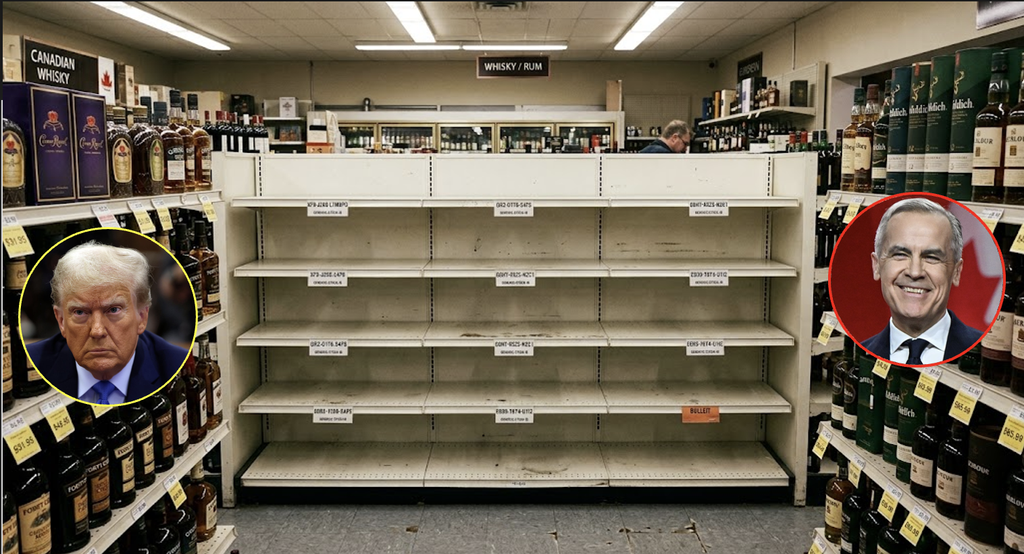
Provincial liquor boards pulled American alcohol off the shelves.
In eight of Canada’s ten provinces, alcohol retail is a government monopoly. That made the decision unusually simple to execute. There was no need to persuade thousands of independent retailers, no need to police compliance. A single directive emptied the shelves.
Within days, Kentucky bourbon, California wine and Texan vodka were gone from stores in Ontario, British Columbia and Quebec.
What it cost
The figures are now in, and they are not marginal.
In 2024, American alcohol exports to Canada totalled US$744 million, more than 20 per cent of everything Canada imported in the category. Canada was not a side market. For many American producers it was a stable, low-risk entry point into international trade, and the second-largest destination for American spirits anywhere.
By 2025, that total had fallen to US$208 million.
A wipeout of $536 million in a single year.
Broken down by category:
Wine was hit hardest, falling from $460 million to $103 million, a drop of 78 per cent. The American share of Canada’s imported wine market collapsed from 21 per cent in 2024 to 5 per cent in 2025.
Distilled spirits fell from $238 million to $89 million.
Beer fell from $47 million to $17 million.
Canada slid from the second-largest destination for American spirits to sixth. Measured from March to December, the period after the shelves were cleared, exports fell from $203 million in 2024 to $60 million in 2025.
What it did to individual companies
Aggregate figures hide the specifics, and the specifics are where this becomes a story about businesses rather than statistics.
Brown-Forman, the Kentucky company behind Jack Daniel’s and Woodford Reserve, reported Canadian organic net sales down more than 60 per cent in the first half of its 2026 financial year, and 59 per cent across the nine months to the end of January.
Chief executive Lawson Whiting called the boycott “worse than a tariff” and a “very disproportionate response.” His reasoning is worth understanding: a tariff raises your price and you lose some customers. Removal from the shelf means you sell nothing at all. He also noted that Canada accounts for only about one per cent of Brown-Forman’s total sales, which is true, and which did not stop him raising it repeatedly.
Jim Beam paused production at its main American distillery after slumping demand produced a whiskey glut. The company did not attribute the decision to Canada specifically.
Phillips Distilling, a Minnesota firm, saw Canadian sales fall about 70 per cent and responded by moving some production of Sour Puss, a liqueur popular with young Canadian drinkers, north of the border.
Campari, the Italian group that owns Wild Turkey and Skyy Vodka, saw Canadian revenue fall 5 per cent.
And the inventory piled up. The Kentucky Distillers Association reported the state held 16.1 million barrels of bourbon at the start of the year, a record high. American whiskey inventories nationally are also at an all-time peak.
What it cost Canada
This is the part most coverage skips, and it matters for credibility.
The Liquor Control Board of Ontario is one of the largest alcohol buyers in the world. It posted a $400 million revenue decline, including roughly $70 million in lost high-margin American liquor sales. Its third-quarter sales came in at C$1.88 billion, down from C$1.98 billion the year before.
That is public money. Liquor board profits go to provincial treasuries and fund public services.
The Vancouver International Wine Festival, which drew almost 20,000 people last year, featured just six American wineries this year, less than half its usual number. The festival’s spokesperson attributed that entirely to the British Columbia ban.
Canadians did not stop drinking. They switched. But the provinces gave up margin to do it, and chose to.
The pressure to reverse it
Washington noticed, and has been trying to get the boycott lifted for more than a year.
Canada’s own 25 per cent tariff on American alcohol, imposed on 13 March 2025, was lifted on 25 August. The provincial shelf bans stayed.
That distinction is the heart of the matter. A tariff is a government measure that can be negotiated away in a trade deal. A provincial decision about what to stock is not a tariff, is not covered by trade agreements in the same way, and belongs to provincial governments that are not party to the negotiations.
In April 2026, Jamieson Greer, the US Trade Representative, said American levies on Canadian industrial goods would remain and could be tightened unless Canada lifted its alcohol restrictions.
Pete Hoekstra, the American ambassador, has cited the boycott as a reason officials describe Canada as “mean and nasty to deal with.”
Carney pushed back sharply. And eighteen months on, most provinces have not moved.
Beyond the bottle
Alcohol is the clearest case because the data is clean and the decision was centralised. But it was never the whole of it.
Travel. Canadian trips to the United States fell roughly 25 per cent in 2025. The US Travel Association costed Canadians simply staying home at more than $5.7 billion. Duty-free shops along the northern border reported revenue down between 40 and 80 per cent.
Groceries. Loblaw reported sales of American-sourced products down 15 to 20 per cent, with some lines closer to half. The American share of Canadian vegetable imports fell from 69 per cent in 2023 to 62.6 per cent by July 2026, with the gap filled by Morocco, South Africa, Spain, Brazil and Honduras.
None of that was a government programme. Nobody was instructed to check a label or cancel a holiday.
The honest qualifications
Four, and they deserve stating.
Not all of this is the boycott. The American wine industry was already struggling. Global exports excluding Canada fell 18 per cent between 2022 and 2023, before any of this started. Wine faces a demand slump driven by competition from ready-to-drink cocktails, generational shifts and rising concern about alcohol and health. A pre-trade-war report from Silicon Valley Bank noted fewer American consumers see wine as their preferred drink.
Canada is a small share of most producers’ revenue. Whiting is right that Canada is about one per cent of Brown-Forman’s sales. The damage is concentrated in specific companies and specific states rather than spread across the American economy.
Canada paid for it. Four hundred million in lost LCBO revenue is public money that would otherwise have funded provincial services.
And boycotts decay. Consumer attention is finite. This one has held unusually long, but the longer it runs, the more it depends on provincial governments maintaining a policy rather than on shoppers maintaining a habit.
What it actually demonstrated
The White House published a document last August titled “President Trump Is Finally Ending Canada’s Free Ride,” listing eleven grievances. Among them: the collapse of American alcohol exports to Canada.
That is worth sitting with. A collapse in consumer demand, produced by provincial retail decisions and forty million people changing what they buy, entered the formal American case against Canada as evidence of unfair treatment.
It is also the clearest measure available of something the tariff debate usually misses. Trade policy assumes governments act and consumers follow. Here it ran the other way. The shelves were cleared by provincial boards, but the sustained part, the travel, the groceries, the label-checking, was never ordered by anyone.
Five hundred and thirty-six million dollars of trade disappeared in a year, and the instrument was a decision about what to stock, followed by a country that did not change its mind.
Sources
- Canada is kicking its US booze habit as trade tensions persist, The Conversation
- US spirits exports to Canada drop 70%, The Spirits Business
- How much damage have Canada’s booze bans done to the U.S. wine industry?, CBC News
- US whiskey exports to Canada collapse nearly 70% after Trump tariff fight, Fox News
- Trump Pressures Canada to End Boycott of US Liquor, Transport Topics