
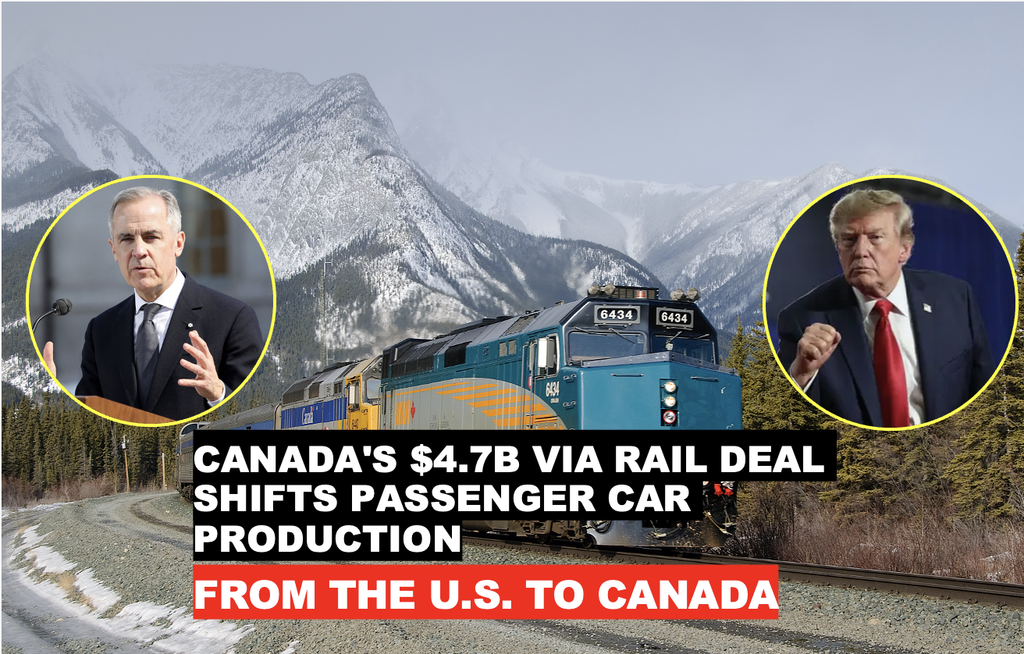
Via Rail’s last fleet was assembled in Sacramento. Its next 313 cars will be built in Ontario and Quebec, the first made in Canada in four decades.
On a Sunday afternoon in late August, after trade talks collapsed, Donald Trump issued an instruction to an entire country’s private sector.
“Let all Canadian Companies that are doing business with America move to the United States, immediately. Many of them are Companies that moved out years ago due to stupid U.S. Leadership. When you move back, there are no TARIFFS!”
Minutes later, a second post. “I don’t want Canadian cars, I don’t want Canadian parts, I don’t want Canadian anything.”
And then a deadline: 50 per cent tariffs on Canadian cars, trucks, auto parts and steel from January 1, 2027.
The pitch was simple. Build in America, or pay.
Two weeks later, Ottawa placed an order for 313 passenger rail cars. It went the other direction.
What changed direction
Via Rail’s previous major fleet order went to Siemens, for new trainsets on the Quebec City to Windsor corridor. Those trains were assembled in Sacramento, California.
That was a defensible decision on its own terms. Siemens offered a proven design at a competitive price. But it meant Canada’s national passenger railway was buying its equipment from an American factory while Canadian rail plants looked for work.
This order goes to Alstom. The carbodies will be built in La Pocatière, Quebec. Final assembly takes place in Thunder Bay, Ontario. Design and engineering will be done at Saint-Bruno-de-Montarville, Quebec.
They are the first Via cars built in Canada in roughly forty years.
Carney announced the contract on September 3, standing on the factory floor in Thunder Bay.
Two plants with long memories
Neither factory is new to this work, and their histories explain why keeping them busy matters.
La Pocatière is where Bombardier began building rail equipment in the 1970s, starting with cars for the Montreal Métro. It became one of the core manufacturing sites behind Bombardier’s rise into one of the largest rail builders in the world.
Thunder Bay has an older story. The plant descends from Canadian Car and Foundry, which during the Second World War built Hawker Hurricane fighters at Fort William. The chief aeronautical engineer on that programme was Elsie MacGill, the first woman in Canada to earn a degree in aeronautical engineering. The press called her the Queen of the Hurricanes. After the war, the site turned to rail and transit vehicles and kept building them for decades.
In 2021, the French manufacturer Alstom bought Bombardier Transportation, and with it both plants. Alstom is now the last passenger train manufacturer operating in Canada, with around 5,200 employees here.
Why the cars are needed
There are towns in this country you cannot drive to.
On Via’s long-distance routes, several stops have no highway at all. Churchill, on Hudson Bay, is the best-known example. For the people who live there, the train is not a scenic option. It is the way in and out, the same way a road is anywhere else.
Those routes run on a fleet averaging 77 years old. Some of the cars still in service were built before Newfoundland joined Confederation in 1949.
That age is partly a legacy of how Via began. It was created as a Crown corporation in 1977 to take over the passenger services Canadian National and Canadian Pacific had been running at a loss. It inherited their equipment, and rather than replace it, Via spent decades refurbishing and rebuilding stainless steel cars from the 1950s and earlier. That kept the trains running. It also left Canada’s cross-country passenger service depending on rolling stock older than most of its riders.
What is being bought
The total is $4.7 billion. About $4 billion pays for the 313 cars themselves. Close to $700 million covers fifteen years of technical support and spare parts.
There are nine types of car, including sleepers, dining cars, domes and panorama cars. That mix reflects how these routes are really used. On the Canadian, between Toronto and Vancouver, passengers travel for four days. On the northern lines, trains carry residents, supplies and tourists together. People eat, sleep and live on these trains for days, not hours.
The new fleet will serve eight routes linking close to 400 communities: Halifax, Gaspé, Jonquière, Senneterre, Sudbury, White River, Churchill, Prince Rupert, Jasper and Vancouver.
What it keeps in Canada
Alstom expects up to 670 direct jobs, plus hundreds of indirect ones. The work draws on more than 900 Canadian suppliers, with Canadian steel used in the structural assemblies. Ottawa puts the economic benefit above $1.6 billion.
The order is also part of something larger. In July, the federal government committed a further $1.95 billion to rail, including 45 hybrid locomotives from Stadler and a $357 million assembly and maintenance facility in Montreal. Total federal fleet renewal now exceeds $6.6 billion.
The criticism, stated plainly
Three objections deserve to be taken seriously.
It is slow. The first new cars arrive in 2031, and the order finishes in 2035. Anyone riding a 77-year-old coach this winter will wait at least five more years, and in some cases closer to ten. For communities with no road, that is a long time to depend on equipment already overdue for replacement.
It costs more. Buy Canadian procurement means paying more than you would to the cheapest supplier. Taxpayers carry that premium. It is a real cost, and it should be named as one rather than folded quietly into the jobs figures.
And “built in Canada” is not “Canadian-owned.” Alstom is a French company. The plants, the jobs and the suppliers are here, but the ownership, the intellectual property and the profits sit in Paris.
It is also worth being clear about cause and effect. The decision was not made because of the August posts. A contract of this size takes years to design, tender and negotiate, and this one was underway long before Trump told Canadian companies to move south. The two events point in opposite directions. One did not cause the other.
The argument for it
Carney’s case is about capacity rather than price.
Canada, the argument goes, spent decades importing things it was perfectly capable of building, and in doing so lost the ability to build them. Plants close when the orders stop. Skilled workers retire or leave. Suppliers go out of business. Once that industrial base is gone, rebuilding it costs far more than keeping it alive would have.
On that view, the premium on domestic procurement is not a flaw in the policy. It is the price of still having a train industry at all.
Whether that holds depends on what comes after. When the last of these 313 cars leaves Thunder Bay in 2035, the plant will need another order. If there is one, the premium will have bought something lasting. If there is not, it will have bought an expensive fleet of trains and a factory that goes quiet again.
Two instructions, one plant
In August, Canadian companies were told to move to the United States, immediately, and that there would be no tariffs if they did.
In September, a plant that built fighters for the Second World War and rail cars for decades after received a $4.7 billion order, 900 suppliers behind it, and a production run lasting until 2035.
He asked Canadian companies to move south. This one is staying.
Sources