The United States wants cheaper fertiliser than Canada supplies. The country it named as the alternative says its entire output is already contracted, and the shipping route runs through Russia.
On Monday, the President of the United States announced a deal.
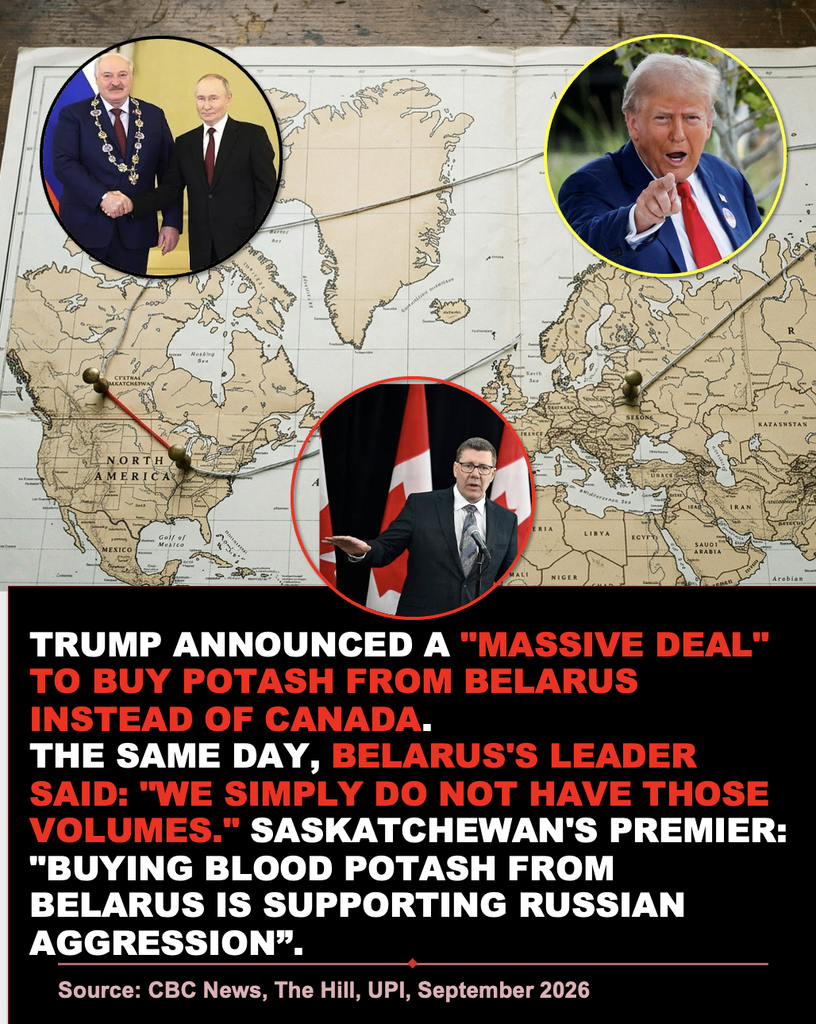
“The United States is working on a massive Deal with respect to the purchase of Potash from Belarus,” Trump wrote on Truth Social. “The pricing would be for substantially less than we are currently paying to Canada, very good news for our Farmers and Ranchers.”
On the same day, the leader of Belarus explained why that deal could not happen.
“Even if we wanted to supply potash to other, Western markets, we simply do not have those volumes,” Alexander Lukashenko said in remarks published by his office. “Everything is contracted for this year.”
The supplier Washington named as Canada’s replacement has nothing left to sell.
What potash is, and why it matters
Potash is potassium. It is the K in the three numbers printed on every bag of fertiliser, alongside nitrogen and phosphorus, and it has no substitute. Corn, soybeans, wheat and canola all need it. A shortage does not show up at the grocery till straight away. It shows up a season later, as smaller harvests, and then in food prices.
Fertiliser is responsible for roughly half of all food production on earth.
The United States produces very little potash of its own. It imports more than 90 per cent of what its farmers use. In 2025 it imported roughly 13 million tons, and according to the United States Department of Agriculture, nearly 90 per cent of that came from Canada.
Why it all comes from one province
Around 400 million years ago, an inland sea covering what is now Saskatchewan evaporated. It left behind the Prairie Evaporite Deposit, a band of mineral salts buried roughly a kilometre underground. It is the largest known potash deposit in the world.
Canada supplied almost a third of global potash production in 2024, according to Natural Resources Canada. Every one of the country’s ten active potash mines is in Saskatchewan. Four companies produce all of it: Nutrien, Mosaic, Compass Minerals and K+S. BHP’s Jansen mine, one of the largest under construction anywhere, is scheduled to begin commercial production in mid-2027.
Canada exported $4.2 billion worth of potash to the United States in 2025.
That dependency is written into American trade policy. When the Section 338 tariffs were issued in July, potash was excluded from them, along with energy and critical minerals, while Canadian alcohol, motorcycles and dairy were banned outright. A government choosing which imports to tax is also publishing a list of the ones it cannot do without.
Why Belarus
Belarus is, after Canada and Russia, one of the world’s largest potash producers. In 2020 it accounted for roughly 17.6 per cent of global output, around 12.2 million tonnes.
It is also governed by Alexander Lukashenko, who has held power since 1994 and is Vladimir Putin’s closest ally. Belarusian territory was used as a staging ground for the invasion of Ukraine in 2022.
For those reasons, Western countries sanctioned Belaruskali, the state-owned potash producer, and its export arm, the Belarusian Potash Company. More than 40 countries, including Canada, still maintain sanctions against Belarus.
The United States no longer does.
On March 26, 2026, the Treasury Department’s Office of Foreign Assets Control removed Belaruskali and the Belarusian Potash Company from its sanctions list. It was part of a deal in which Belarus released 250 political prisoners. Last week, Belarus agreed to release 25 more under a further arrangement.
Washington’s special envoy, John Coale, met Lukashenko in early September. On September 11, Lukashenko announced that Belarus had resumed selling potash to the United States, while noting that most of its production was already contracted. He also asked for the return of more than $40 million he says remains frozen in the American banking system. Coale later said Washington was working on a way to release those funds.
The route problem
Even if Belarus had potash to sell, getting it to America is difficult.
Belarus is landlocked. For years, more than 90 per cent of its potash exports, roughly 10.8 million tonnes a year, left through the Lithuanian port of Klaipėda on the Baltic. In February 2022, Lithuania closed that route, largely in response to American sanctions. Lithuania, a NATO and EU member, has since said it will not be pressured into reopening it.
That leaves Russia. Belarusian potash headed for America would now have to travel through Russian territory, out through Russian ports, and across the Atlantic.
Jason Childs, an economist at the University of Regina, is doubtful this makes the product any cheaper. “I’m skeptical just because you’ve got so much more transportation to deal with,” he told CBC. Unless Belarus has dramatically lower production costs, he said, he doesn’t see it being much of a boon for the American farmer.
Fertilizer Canada, the industry’s trade group, put the counter-argument plainly: reliability, proximity, transportation infrastructure, product availability, and the ability to deliver during critical application windows all matter. Fertiliser has to arrive when the ground is ready. A cheaper shipment that arrives late is not cheaper.
Saskatchewan’s answer
Scott Moe, the premier of Saskatchewan, responded within hours.
“Buying blood potash from Belarus is supporting Russian aggression,” he wrote. “It’s wrong and it doesn’t make sense.”
He pointed to the sanctions still maintained by more than 40 countries, and asked the obvious question: “Does anyone believe Belarusian blood potash shipped through Russia is going to be more affordable, more sustainable or more ethical than potash shipped from Saskatchewan, right here in North America?”
Moe leads the conservative Saskatchewan Party. He is not usually among Washington’s harshest critics, which is exactly what gives the phrase its force.
The provincial NDP called Trump’s post infuriating, describing Belarus as an authoritarian Russian satellite state supporting Putin’s war against Ukraine.
Two arguments that cut the other way
This is not simply a story of a bad idea, and it is worth being fair about why.
American farmers genuinely are under pressure. New Orleans potash spot prices are at their highest since July 2023. Diesel and nitrogen fertiliser costs have risen sharply because of the war with Iran and the closure of the Strait of Hormuz, through which a large share of the world’s fertiliser trade normally passes. Farmers are a core constituency heading into November’s midterms, and wanting cheaper inputs is not unreasonable.
And the deal does not need to succeed to hurt Saskatchewan. Childs made this point himself. Belarus and Russia have been largely absent from the North American potash market, and Canadian producers have benefited from that absence. If they enter it, even at a modest scale, the extra supply would push prices down. Lower prices land directly on Saskatchewan’s mines, its workers, and the royalties the provincial budget depends on.
A threat can do damage without ever being carried out.
The timing
Trump’s potash post came on the same day he wrote, about the war in Ukraine, that “Russia has unfortunately lost control of its Diesel Oil Industry due to its War with Ukraine. A large number of their Diesel refineries have been blown up and are, at least temporarily, out of commission.”
One post expressing regret at damage to Russia’s energy sector. Another proposing to source fertiliser from Russia’s closest ally, instead of from a NATO neighbour that supplies a third of the world.
What the plan rests on
Strip out the announcement and look at what remains.
A supplier whose own leader says it has no spare volume, because everything is contracted for the year.
A shipping route that a NATO ally has closed and refuses to reopen, leaving Russia as the only way out.
A price that nobody, on either side, has actually quoted.
And a replacement for Canada, which supplies nearly nine of every ten tons America imports, drawn from a country more than 40 of America’s allies still sanction.
Potash was exempted from the tariffs in July because Washington concluded it could not do without Canadian supply. Nothing in Monday’s announcement changes that conclusion. If anything, Lukashenko’s reply confirmed it.
Sources
- Saskatchewan Premier Scott Moe defends province’s potash industry, CBC News
- Belarus says it can’t supply U.S. potash as Trump says deal underway, UPI
- Belarus says no potash left after Trump claims massive deal for fertilizer, The Hill
- Trump says Belarus potash deal in works amid Canada fight, Bloomberg via MINING.COM
- Belarus struggling to find path to market for potash amid US sanctions, S&P Global