
Until last year, Canadian natural gas had almost no way to reach any market except the United States. Now there is 13 million tonnes a year of export capacity pointed at Asia, a plan to triple it, and Ottawa has just approved another expansion.
For most of its history, Canadian natural gas had exactly one way out of the country.
It went south, by pipeline, to the United States. Not because Canadian producers preferred it, and not because the price was good, but because gas in its natural state cannot be loaded onto a ship. It moves through pipes, and for a century the pipes ran in one direction.
That single fact shaped the economics of an entire industry, and it explains why a small expansion approved on the Fraser River this week belongs to a much larger story.
One buyer, one price
A seller with one customer does not set the price. The customer does.
This is not a theory about Canadian energy. It is visible in the numbers, and it applies to both oil and gas.
Oil first, because the figures are well established. Western Canadian Select, the benchmark for Alberta’s heavy crude, has always traded below the American benchmark. Part of that gap is chemistry: the crude is heavier and costs more to refine. The larger part was geography. Alberta is landlocked, and for decades its oil could only go south.
The discount has averaged roughly $17 to $20 a barrel over the long run. In November 2018, when the pipelines were full and there was nowhere else to send the oil, it blew out to around $46. A Fraser Institute analysis put the lost revenue to Canadian producers at roughly $20 billion in a single year. Those dollars did not disappear. They stayed on the American side of the border, in refining margins.
Gas followed the same logic. The Canadian benchmark is AECO, a trading hub in Alberta. The American benchmark is Henry Hub in Louisiana. AECO has consistently traded below Henry Hub, and the gap is large.
Natural Gas Intelligence data showed AECO averaging about $1.38 per million British thermal units below Henry Hub over the twelve months to early 2025, wider than its five-year average of about $1.13. The Alberta Energy Regulator expected the differential to average around $1.80 in 2025, widening to about $2.10 under its tariff scenario, because American tariffs on Canadian energy pushed the Canadian price down further. By June 2026, forward prices put AECO around $1.91 below Henry Hub for the summer.
In percentage terms the gap is striking. Forward prices for 2026 put Henry Hub around $4.01 and AECO around $2.35. Canadian gas was expected to sell for roughly 40 per cent less than American gas, for what is physically the same molecule.
And at the extreme, the relationship inverted entirely. Western Canada has experienced bouts of negative pricing at AECO, meaning producers paid buyers to take their gas. With storage full and nowhere else to send it, some producers found it cheaper to pay someone to take the molecules than to face penalties for missing their production and transport commitments.
A commodity that sometimes has to be given away with cash attached is a commodity with a customer problem.
The physics that changed the trade
The escape from that problem is a matter of temperature.
Cool natural gas to around minus 162 degrees Celsius and it becomes a liquid, shrinking to roughly one six-hundredth of its volume. In that form it can be loaded into insulated tanks on specialised ships and carried across an ocean.
That is liquefied natural gas. It turned gas from something tied to a pipeline network into something that can reach any port in the world, and sell into whichever market is paying most.
LNG carriers are recognisable from a distance: tankers with large rounded or box-shaped containment tanks rising above the deck. They are what allow a molecule produced in northeastern British Columbia to end up in Tokyo, Seoul or Rotterdam.
Canada came late
The United States, Australia and Qatar spent two decades building LNG export industries. American terminals on the Gulf Coast became some of the largest in the world. Australia turned LNG into one of its most valuable exports.
Canada, with some of the largest gas reserves on earth, exported almost none.
The obstacles were real. Terminals are enormously expensive. They take years to permit and build. They require pipelines across mountain ranges to reach the coast, and those pipelines crossed Indigenous territory where consent was not automatic. Several proposed projects in the 2010s were cancelled when prices fell or approvals stalled.
Kitimat
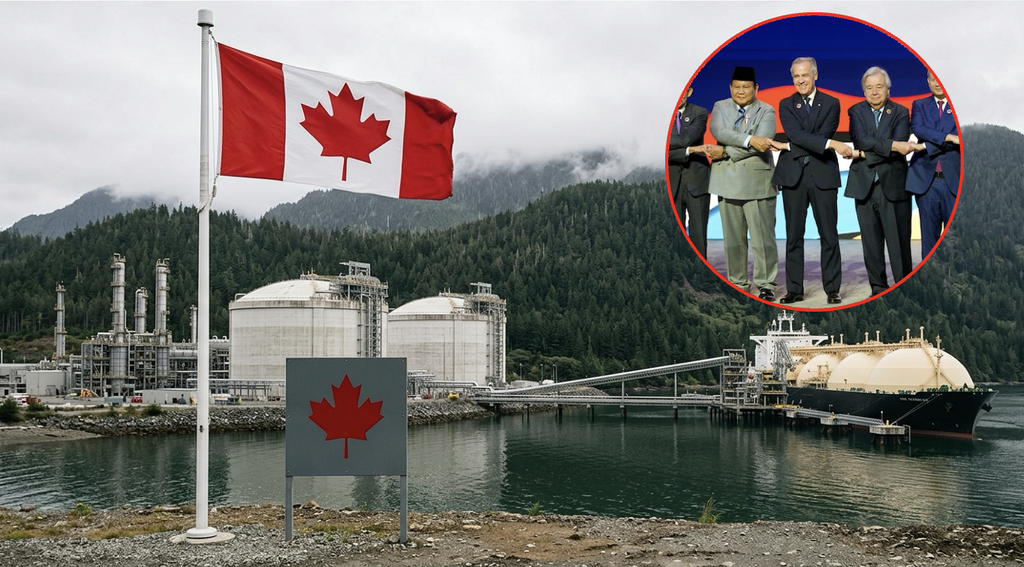
The first one to get built was LNG Canada, at Kitimat, at the head of a fjord on the northern British Columbia coast.
It shipped its first cargo in mid-2025. Both of its processing trains now operate, each capable of about 6.5 million tonnes a year, for roughly 13 million tonnes in total. It is fed by the Coastal GasLink pipeline, which can carry about 2.1 billion cubic feet a day to the terminal. At full operation, LNG Canada’s feed gas represents more than ten per cent of Western Canada’s entire supply.
Canadian gas production reached record levels in 2025, averaging about 19 billion cubic feet a day, and passed 20 billion in January and February of this year. The Canada Energy Regulator attributes part of that growth directly to the start of LNG exports.
And it is not finished. The LNG Canada partnership has authorised its contractors to begin early work on Phase 2, which would double the terminal’s capacity to about 28 million tonnes a year.
Why the Pacific matters
The location may matter more than the volume.
American Gulf Coast terminals mostly serve Europe and Latin America. A terminal on Canada’s Pacific coast has a direct route to Asia, the largest LNG market on earth, and the shipping time to Japan and Korea is dramatically shorter than from the Gulf of Mexico, which must either pass through the Panama Canal or sail around Africa or South America.
For Asian buyers, that shorter voyage means lower shipping cost and less exposure to chokepoints. It is one of the few structural advantages Canadian gas has over American gas, and it is the reason the West Coast is where the industry is growing.
What comes next
Ksi Lisims, on Nisga’a treaty land on the northern coast, is designed for 12 million tonnes a year. Germany’s SEFE and Uniper have signed twenty-year supply contracts for three million tonnes a year between them, with first deliveries expected in 2032. The Nisga’a Nation holds a significant stake. A final investment decision is targeted for this year.
The German contracts carry their own weight. SEFE was formerly Gazprom Germania, seized and renamed after Russia invaded Ukraine. Uniper was nationalised in 2022 after nearly collapsing when Russian gas stopped. Two companies that learned exactly what dependence on a single supplier costs chose Canada.
More broadly, Carney has said Canada intends to more than triple its LNG output over the coming decade by developing five terminals, alongside roughly $10 billion in Port of Vancouver upgrades.
Tilbury
Which brings us to this week.
On Monday, the federal government approved an expansion of FortisBC’s Tilbury LNG facility, on Tilbury Island in the Fraser River at Delta. The approval came immediately after British Columbia issued its environmental assessment certificate, under the principle of “one project, one review,” which allows a single assessment to satisfy both governments rather than running two in sequence.
The project adds a large new storage tank and equipment capable of producing up to 7,700 tonnes of LNG a day, roughly 2.8 million tonnes a year.
British Columbia estimates it will generate 6,200 full-time-equivalent years of employment during construction, 100 permanent jobs, and up to $1.7 billion in provincial GDP while it is being built.
Environment Minister Julie Dabrusin described it as showing how to create jobs and grow the economy while protecting the environment and advancing reconciliation.
The honest limits
Four of them, and they matter.
Tilbury is not Kitimat. It is considerably smaller, and much of its existing output has historically fuelled ships and supplied British Columbia customers rather than overseas buyers. It adds to Canada’s LNG capacity, but it should not be mistaken for a major export gateway.
The approval acknowledges harm. Ottawa’s own decision states that the project’s potential adverse effects are justified by its benefits, which is an explicit acknowledgement that adverse effects exist. The facility sits on the Fraser River, and every new LNG terminal commits the country to decades of gas production at a moment when climate commitments point the other way. That argument is not settled, and serious people hold both positions.
LNG may not close the discount. This is the counterintuitive one. FactSet senior energy analyst Connor McLean has argued that LNG Canada is not necessarily bullish for AECO prices over the long term, because Canadian production will simply grow to fill the new demand. If producers drill more to feed the terminals, the regional oversupply that created the discount could persist. The export route helps, but it does not guarantee higher prices at home.
The pipeline still dominates. For all the growth on the Pacific, the overwhelming share of Canadian gas exports still moves south by pipeline to the United States. Thirteen million tonnes of LNG is a meaningful new outlet. It is not yet a replacement for the old one.
What it adds up to
For a century, Canadian gas sold at a discount because there was only one place it could go. At its worst, producers paid buyers to take it.
That constraint was never about the gas. It was about the absence of a second customer.
LNG is how a second customer becomes possible, and Canada has now built the first piece of it, is building the second, and has approved more. The discount may or may not close. But for the first time, the price of Canadian gas is not decided entirely by whoever sits at the other end of the pipe.
Sources
- Will Canada’s LNG Exports Matter for AECO Natural Gas Prices?, Natural Gas Intelligence
- Canada’s AECO Natural Gas Prices Retreat Despite Looming US Demand, Natural Gas Intelligence
- Natural Gas Prices, Alberta Energy Regulator
- Western Canada Gas: LNG’s Impact on AECO Prices, Enverus
- AECO Natural Gas Prices Firming on Rising LNG, Winter Demand, Natural Gas Intelligence