
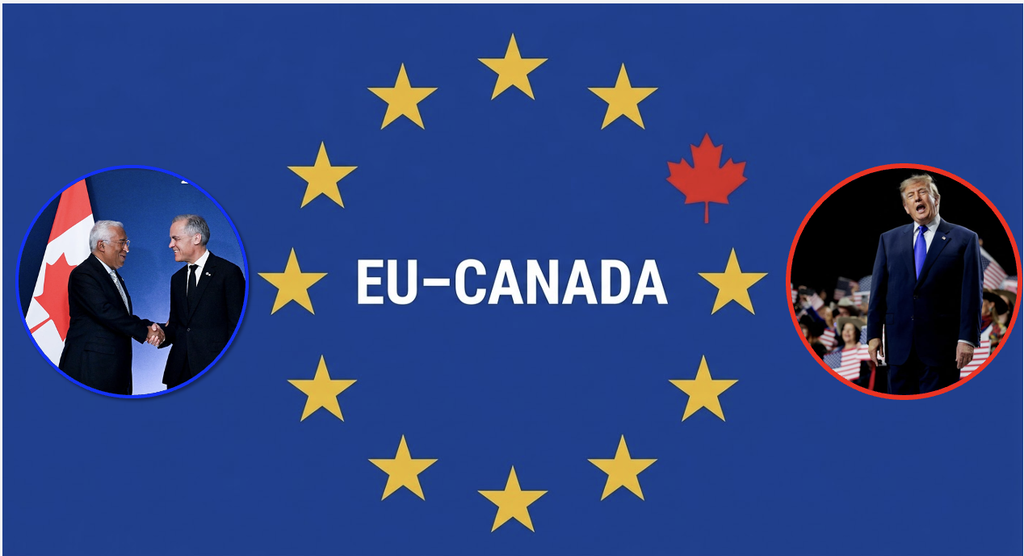
Eighteen months ago Washington told the EU and Canada not to work together. This week the president of the European Council named defence, AI, quantum computing and democracy as the areas where they will.
In March 2025, Donald Trump posted a warning aimed at two allies at the same time.
“If the European Union works with Canada in order to do economic harm to the USA, large scale Tariffs, far larger than currently planned, will be placed on them both.”
It was a condition attached to a threat, and the condition was simple: do not work together.
What followed was a long campaign of pressure on both. Tariffs on Canadian steel, aluminum and autos. Tariffs on European exports, eventually settled in a framework that put a 15 per cent levy on most European goods entering America. Repeated talk of Canada becoming the 51st state. Last month, after trade talks with Ottawa collapsed, fresh tariffs on Canadian goods and bans on Canadian alcohol, motorcycles and dairy. And last week, after Brussels offered Canada a new form of membership, Trump called the idea laughable and warned that if he judged it a hostile act, he would put very serious tariffs on Europe or stop trading with it on many things.
For most of that period, the warning seemed to shape how carefully both sides spoke. That has now changed, and the change is coming from the top of European institutions.
What Costa said, and why it matters who said it
António Costa is president of the European Council, the body that brings together the heads of government of all 27 member states. That distinction is worth understanding. Ursula von der Leyen runs the European Commission, the EU’s executive arm, and it was she who offered Canada “associate membership” in her State of the Union address. The European Council is where national governments sit. When its president speaks, he is speaking closer to the capitals themselves.
In an interview with POLITICO in Dublin, Costa said the EU wants to develop “the closest possible” relationship with Ottawa, and to “do more” and “act as much as possible with Canada.”
Asked to define the associate membership von der Leyen had proposed, he kept it plain. The concept, he said, basically means we want to do more and act as much as possible with Canada. Then he added, drily, that there is “just this small problem that geographically they are not a European country,” which means Canada cannot apply for membership in the ordinary way.
It was a light line, but it did useful work. It acknowledged that the EU’s own rules restrict full membership to European states, which is why any arrangement with Canada has to be something new rather than a version of what already exists.
He then described what “more” would actually involve. The EU, he said, can do much more with Canada than only trade. “We can work on defence and security. We can work on investment in AI, quantum, the new technological challenges.” And: “We can work with them to strengthen democracy, because we are like-minded and reliable partners.”
Look at that list closely. Defence, artificial intelligence, quantum computing, democratic institutions. Not one of them is primarily a matter of trade, and none of them can be reached by a tariff. Trump’s warning was framed around economic harm to the United States. The cooperation Costa describes sits largely outside the space tariffs can touch.
This is not coming from one voice
Costa is not the first senior European to answer the warning, and the accumulation matters more than any single statement.
When Trump called the Canada offer laughable, France’s Europe Minister, Benjamin Haddad, responded the next morning that it is not up to the United States, or anyone else, to choose the political and geopolitical direction of the Europeans.
The European Parliament announced it will open an office in Ottawa, only its third in North America after New York and Washington. Carney addressed the Parliament in Strasbourg, the first head of government to attend a State of the European Union address, and received a standing ovation. The president of the European Investment Bank, the EU’s lending arm and the world’s largest multilateral lender, visited Canada and said the bank intends to invest in Canadian critical minerals, adding that “the sky’s the limit.”
Beneath all of it sits a relationship that already has substance. Canada was the first and only non-European country admitted to SAFE, the EU’s €150 billion defence procurement programme, a status Britain does not have. Canada has been in the European Space Agency since 1979 and in Horizon Europe, the EU’s research programme, since 2024. Canadian goods exports to the EU rose 23.4 per cent in 2025, the largest increase on record, in the same year exports to the United States fell 5.3 per cent.
Costa’s interview is the latest statement in a sequence, and the sequence all points one way.
What happens next
Costa identified the EU-Canada summit in Montreal on October 29 and 30 as the moment the future relationship will be defined. That is where a name, a structure and a set of commitments are supposed to replace the current mix of ambition and uncertainty.
Before that, on Monday in New York, on the margins of the UN General Assembly, Costa co-hosts a public event on multilateralism with Carney and Kenya’s president, William Ruto. It is a small event, but the pairing is deliberate: the head of the European Council and the prime minister of Canada, on a stage together in the United States, speaking about the value of international cooperation.
Carney has said that whatever arrangement emerges will be debated and voted on in Canada’s Parliament. His ambassador-designate to the EU, Jonathan Wilkinson, has ruled out Canada paying into the EU budget. Ottawa’s framing has been consistent: an alliance focused on what Carney calls strategic capabilities, not membership.
The honest limits
Three of them are worth keeping in view.
The first is that Europe is not fully aligned. POLITICO reports that von der Leyen’s associate membership offer came as a surprise to many European governments, which are still trying to work out what it would actually mean. Offers made from a podium in Strasbourg still have to survive the national capitals, and that is where ambitious ideas in Brussels have a habit of slowing down.
The second is that the existing agreement is not finished. CETA, the Comprehensive Economic and Trade Agreement, was signed in 2016 and took effect provisionally the following year. Nine years later, ten EU member states, including France, Italy and Belgium, still have not ratified it. A relationship that cannot complete the paperwork on a conventional trade deal should be cautious about promising something far more ambitious.
The third is the question of scale. The European Union accounts for less than a tenth of Canada’s total trade. The United States still takes around two thirds. Warm words from Brussels do not change that arithmetic quickly, and no serious person in Ottawa is pretending they will.
What has actually changed
None of those limits alter the central point.
Eighteen months ago, the warning from Washington was specific and conditional: do not work together, or face far larger tariffs. It was designed to make both sides hesitate.
This week, the president of the body representing Europe’s national governments described Canada as a like-minded and reliable partner, named defence and democracy as areas for cooperation, joked about the geography that keeps Canada out of the EU, and pointed to a date in Montreal to settle what comes next.
The threat has not been withdrawn, and Trump restated it only last week. It has simply stopped deciding anything.
Sources