The United States lifted its potash sanctions on Belarus in December 2025, in a deal that freed a Nobel Peace Prize laureate. Nine months later Trump announced a “massive Deal” to buy that potash instead of Canada’s. Belarus produces six million tonnes a year. Canada produces fifteen.
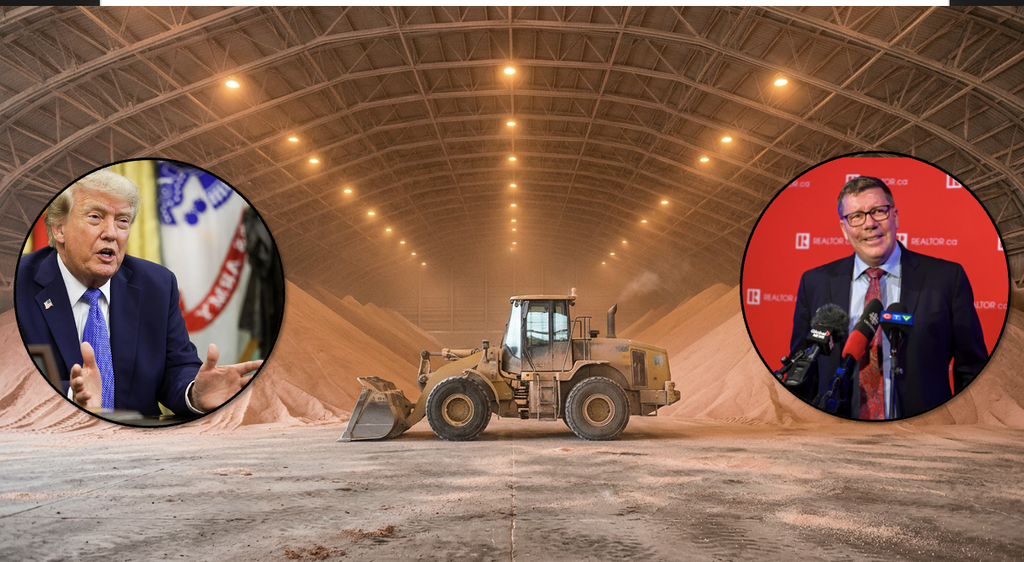
On 21 September 2026, Donald Trump posted this:
“The United States is working on a massive Deal with respect to the purchase of Potash from Belarus. The pricing would be for substantially less than we are currently paying to Canada, very good news for our Farmers and Ranchers.”
Ten days later, Saskatchewan Premier Scott Moe announced that Saskatchewan companies would invest $500 million expanding the Neptune Potash Terminal at the Port of Vancouver. His claim about what that buys: once the work is finished, more Saskatchewan potash will move through that one terminal every year than the entire country of Belarus produces.
Both statements are about the same mineral. Only one of them survives contact with the production figures.
The numbers
Belarus produced roughly 6 million tonnes of potash in 2025.
Canada produced roughly 15 million tonnes — two and a half times as much, almost all of it from Saskatchewan.
Over the four years from 2021 to 2024, Canada supplied about 79 per cent of all American potash imports.
So the proposition is that a country producing six million tonnes replaces a supplier that currently provides four-fifths of American supply from a fifteen-million-tonne base. Before any question of price, there is a question of volume, and the volume does not exist.
How the potash became buyable at all
The part of this story that went largely unreported in Canada is that the deal required dismantling a sanctions regime first.
The United States sanctioned Belarusian potash in August 2021, after the disputed 2020 election and the crackdown that followed. Before that crisis, Belarus had been earning about $2.4 billion a year from potash exports.
On 13 December 2025, Washington lifted them.
The sequence was explicit. Belarus pardoned 123 prisoners that day, following 51 released in September after an earlier American delegation visit — 156 in total. Among those freed were Ales Bialiatski, the Nobel Peace Prize laureate; Maria Kolesnikova, the opposition leader; Viktor Babariko, the former presidential candidate; Marina Zolotova, former editor-in-chief of TUT.BY; and the human rights defenders Valentin Stefanovich and Uladzimir Labkovich.
The American envoy, John Cole, put it plainly: “As directed by President Trump, the US is lifting sanctions on potash.” He added that “more and more sanctions will be lifted” as relations normalised. Across the wider normalisation, Lukashenko released some 250 prisoners.
The mechanics followed over the next three months. General Licence 13 authorised transactions with the potash entities in December. On 26 March 2026, the Treasury formally removed Belaruskali and its subsidiaries, the Belarusian Potash Company and Agrorozkvit LLC from the Specially Designated Nationals list, with General Licence 14 covering Belinvestbank and two other financial institutions.
The stated rationale was global fertiliser supply disruption from the Middle East conflict and its effect on American farm costs.
One detail matters for what comes next: the European Union and the United Kingdom did not follow. Belaruskali and the Belarusian Potash Company remain individually listed on both sanctions regimes. In May 2026, the United States asked three countries to lift their own restrictions on Belarusian potash.
So by the time Trump announced his “massive Deal” in September, the legal obstacles on the American side had been cleared for six months. What remained were the physical ones.
The physical ones
It is already sold. Alexander Lukashenko has said of Belarusian output that “everything is contracted.” China alone takes about 27 per cent of Belarusian potash exports. Capacity that is under contract to existing buyers is not available to new ones without someone losing their supply.
It is the wrong colour. Belarus produces mainly pink potash. The American market mainly consumes white. Converting one to the other means additional processing, which means additional cost — in a deal whose entire premise was that it would be cheaper.
It is a very long way away. Julia Campbell of Argus put the conclusion without qualification: “It is very unlikely that the US will be able to replace all of its potash imports from Canada with Belarusian potash.” Saskatchewan potash reaches American farms by rail. Belarusian potash reaches them by rail to a Baltic port, by ship across the Atlantic, and by barge or rail again from the Gulf.
And nobody was short of potash. One fertiliser analyst’s summary of the whole episode: “We have not struggled to find potash. We have more than enough to go around.”
A first Belarusian cargo did arrive at New Orleans — 30,000 tonnes.
For scale, that is about one two-hundredth of annual Belarusian production, and roughly a day and a half of Canadian output.
The retreat
Trump has since dialled the plan back and said the United States will stick with Canadian potash.
Belarus, for its part, has kept going. On 29 September, Lukashenko proposed that the United States join a Belarus–Gazprom fertiliser project. Belaruskali has set a target of 16 million tonnes of fertiliser output by 2030 — a figure that would, if reached, put it roughly where Canada is today, four years from now.
What Saskatchewan did instead
On 30 September, Moe announced the Neptune expansion: $500 million of private investment from Saskatchewan companies, expanding a terminal on the North Vancouver waterfront.
The logic of that location is worth stating because it is easy to miss. Saskatchewan is landlocked. Every tonne of potash it sells to a non-American buyer travels by rail through the mountains to the Pacific coast, and the capacity of the terminal at the other end is the limit on how much it can sell. Expanding Neptune is not a gesture about Belarus. It is the removal of a bottleneck between Saskatchewan and every market that is not the United States.
It also follows a pattern. Under CETA, European imports of Canadian fertiliser — largely Saskatchewan potash — have risen 225 per cent since 2016. The buyers outside North America were already there. The constraint was getting the product to them.
Moe’s own framing: “In an uncertain world, the world can be certain about Saskatchewan potash.”
What the sequence shows
In August 2021, the United States sanctioned Belarusian potash over a stolen election.
In December 2025, it lifted those sanctions in exchange for 123 political prisoners, including a Nobel laureate.
In March 2026, it formally delisted Belaruskali, the Belarusian Potash Company and Agrorozkvit, while the European Union and the United Kingdom kept their own listings in place.
In May 2026, it asked three other countries to lift theirs.
In September 2026, the President announced a massive deal to buy that potash at a lower price than Canada’s — from a producer at 40 per cent of Canadian volume, whose output is already contracted, in the wrong grade, on the wrong side of an ocean.
Days later, he said the United States would stick with Canada.
And on 30 September, Saskatchewan committed half a billion dollars to shipping more of its potash to everyone else.
Sources
- Trump says he wants potash from Belarus for ‘substantially less’ than Canada, Global News
- Can Belarus Replace Canada As US Potash Provider?, RFE/RL
- US lifts sanctions on Belarusian potash as Lukashenko releases 123 more political prisoners, Euronews
- OFAC Lifts Belarus Sovereign Debt Ban, Eases Sanctions on Belarusian Potash Sector, Cleary Gottlieb
- The U.S. Asked Three Countries To Lift Sanctions On Belarusian Potash, Charter’97
- Trump dials back on Belarus potash, says U.S. will stick with Canada, SaskToday
- Lukashenko Proposes US Join Belarus-Gazprom Fertilizer Project, Reuters via US News
- Belaruskali to ramp up fertilizer output to 16m tonnes by 2030, Belarus.by
- Premier Scott Moe, announcement on the Neptune Potash Terminal expansion, 30 September 2026
- EU-Canada trade: facts and figures, Council of the European Union