
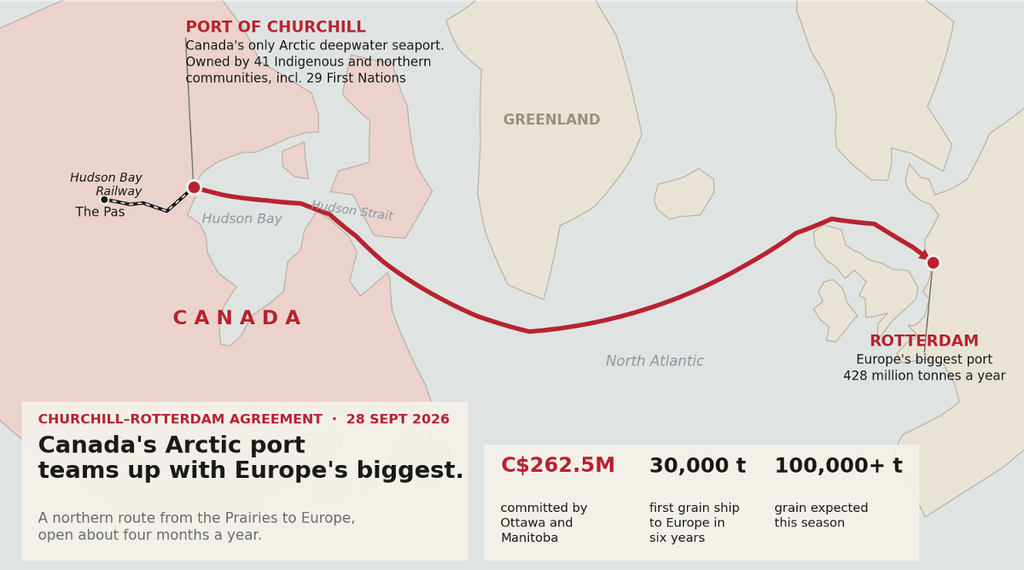
Churchill, Manitoba, owned by 41 Indigenous and northern communities, has signed an agreement with Rotterdam, which handles 428 million tonnes a year. This summer, grain sailed from Churchill to Europe for the first time in six years.
On the twenty-eighth of September, two very different ports signed the same document.
One was Rotterdam: Europe’s largest port, which handled 428.4 million tonnes of cargo and 14.2 million containers in 2025, with an industrial complex of more than 3,000 businesses.
The other was Churchill, on the western shore of Hudson Bay in northern Manitoba. It is Canada’s only Arctic deepwater seaport served by rail, and it ships for about four months a year, between the summer thaw and the autumn ice.
The document is a memorandum of understanding between Rotterdam and Arctic Gateway Group, the company that owns Churchill. Its purpose is to build supply chains between Western Canada and Europe.
The Agreement
The two ports have agreed to:
- Develop resilient supply chains for critical raw materials
- Connect Canadian producers with European customers, investors, shipping lines and industrial partners
- Support energy supply chains, including LNG
- Share expertise on building a port ecosystem
Arctic Gateway’s chief executive, Chris Avery:
“The world is taking notice of what we are building in northern Manitoba, and major European ports recognize Churchill’s value as a shorter, more economical trade route.”
Federal minister Steven MacKinnon:
“This agreement creates an important opportunity to strengthen connections between Western Canadian suppliers and European markets.”
The ownership is what sets Churchill apart. Arctic Gateway Group, which runs both the port and the Hudson Bay Railway from The Pas to Churchill, is owned by a partnership of 41 Indigenous and northern communities, including 29 First Nations. It bought the port and railway in 2018 and became wholly Indigenous- and community-owned in 2021.
Government money is behind it. As of November 2025, Ottawa and Manitoba had committed:
- C$175 million from the federal government
- C$87.5 million from Manitoba
- C$262.5 million in total, over five years
In September 2025, the larger expansion plan, Port of Churchill Plus, was referred to the federal Major Projects Office. It has four parts:
- Upgrading the Hudson Bay Railway to Class 1 standards
- Dedicated icebreaking to extend the shipping season
- An all-weather road to Churchill, which today can be reached only by rail, air or sea
- A new energy corridor
In February, Ottawa launched a market study to test private investors’ interest in the expansion. Federal minister Eleanor Olszewski described the project as part of “building a stronger sovereign presence in our northern and arctic waters.”
The Route Back
Churchill nearly disappeared.
In 2017, flooding washed out the rail line, cutting the port and town off from the rest of Canada by land. The line reopened in November 2018, after Arctic Gateway took over. Then in 2020, the pandemic and further problems with the rail line halted grain exports altogether.
This summer, they returned.
In late August, a ship loaded about 30,000 tonnes of Canadian durum wheat at Churchill, bound for European buyers. It was the first grain to leave the port since 2020. Three grain shipments are expected this season, totalling more than 100,000 tonnes.
Grain isn’t the only cargo. This year Churchill is also handling:
- Zinc concentrate
- Potash from Manitoba
- Resupply cargo for communities in Nunavut
Avery: “We’re very much open for business. We’re once again a strategic asset to Canada.”
Manitoba’s agriculture minister, Ron Kostyshyn: “Churchill provides an important northern gateway that can help diversify our trade, strengthen our supply chains.”
A Churchill resident, Joe Stover, was more direct: “To see grain back after all these years just feels right.”
The limit is ice. Hudson Bay freezes for most of the year, which confines shipping to about four months. Recent research suggests year-round access with icebreakers may be possible at a cost of C$100 million to C$410 million, far below earlier estimates that ran into the billions.
Churchill and Rotterdam are very different in size. Rotterdam handles more cargo in a single day than Churchill expects to ship in grain this entire season.
What Churchill offers instead is distance. It is the shortest tidewater route from the Prairies to Europe, and Canada’s only Arctic seaport connected to the continent’s rail network.
The grain is moving again. The agreement with Europe’s biggest port was signed on the twenty-eighth of September. The port has about four months a year to use it.
Sources
- Port of Churchill and Port of Rotterdam have signed agreement to strengthen transatlantic trade — GlobeNewswire, 29 September 2026
- About Us — Arctic Gateway Group
- Port of Churchill Expansion fact sheet — Canadian Indigenous Investment Forum
- Government of Canada launches market sounding study at the Port of Churchill — Prairies Economic Development Canada, 19 February 2026
- For the first time in six years, the Port of Churchill shipped Canadian grain to Europe — CP24, 31 August 2026
- First grain vessel in six years loaded at Port of Churchill — RealAgriculture, September 2026
- Rotterdam port throughput falls 1.7% in 2025 — Container News
- Port of Churchill — Wikipedia