A leaked draft shows what Ottawa and Brussels plan to announce in Montreal on the 29th of October: linked payment systems, European money for Canadian minerals, and 50 Canadian-built water bombers.
“I think it’s laughable.”
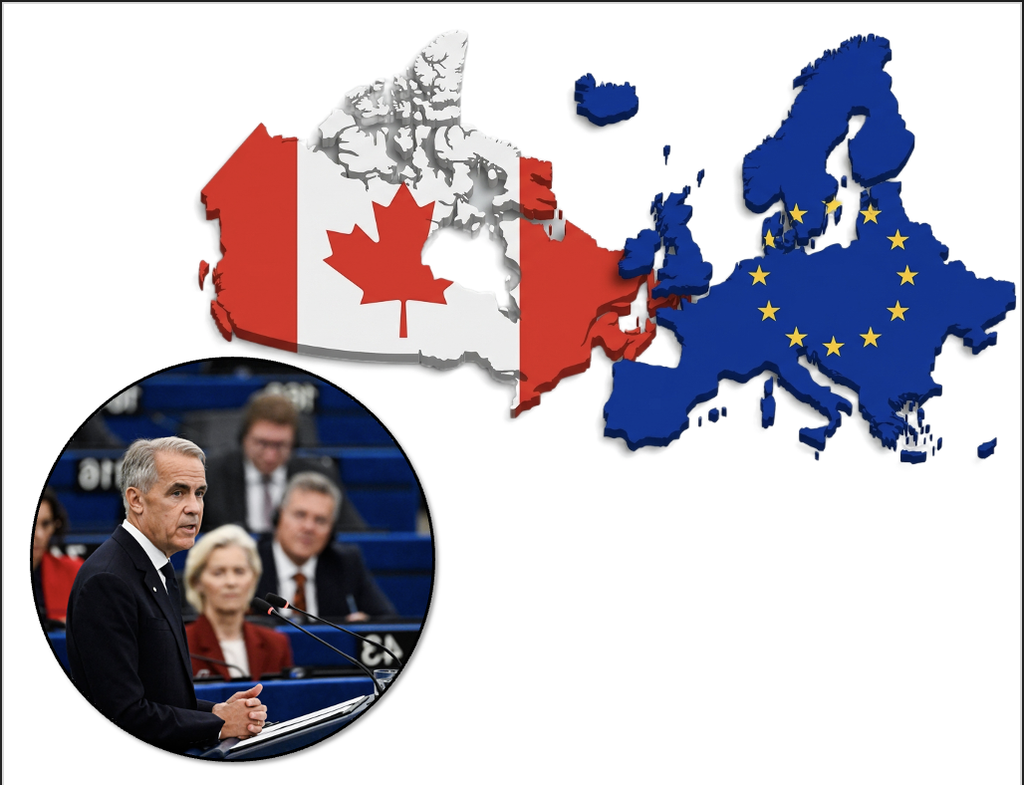
That was Donald Trump’s answer on the 16th of September, when he was asked about Europe’s offer to Canada. Earlier that day in Brussels, European Commission President Ursula von der Leyen, standing beside Mark Carney, said she wanted to work on “opening the door for Canada to be the first associate member of the EU.”
Trump didn’t stop there. If he saw the move as a hostile act, he said, “we’ll put very heavy tariffs on Europe.” He called Canada a “terrible trade partner.” That same day, he signed a memorandum targeting Canadian products in US federal procurement.
The next day, Carney spoke to the European Parliament. He listed payments among the areas where Canada and Europe should cooperate, and he described the goal as “strategic autonomy.”
Three weeks later, we know what that means in practice.
A draft joint statement dated the 21st of September, obtained by POLITICO and The Globe and Mail, sets out what Canada and the EU plan to announce when European leaders arrive in Montreal for a summit beginning on the 29th of October. The two sides are calling it an “Alliance for the Future.”
What’s in the Draft
1. Linked payment systems
Canada and the EU would connect their next-generation payment systems, “making it easier for Canadians and Europeans to conduct business, invest and transfer funds internationally.”
The draft doesn’t say which systems. But Europe is already building its own cross-border network. Vass Bednar of the Canadian Shield Institute points out that Spain’s Bizum, Italy’s Bancomat and the pan-European Wero are linking up.
Why this matters became clear in 2025. After the United States sanctioned the International Criminal Court, Canadian judge Kimberly Prost found she could no longer use most credit cards or services like Amazon. BMO chief economist Douglas Porter calls the Canada–EU link a defensive step, “an alternative option” if the system comes under duress.
2. European money for Canadian minerals
According to the draft, Canada and the European Investment Bank have “completed negotiations of an agreement” on European investment in Canadian resources, especially critical minerals. The two sides would also work together on supply chains and on stockpiling to protect against “market fluctuations and geopolitical impacts.”
3. 50 Canadian-built water bombers
Canada and the EU would jointly buy 50 water bombers from Canada’s De Havilland, to fight wildfires on both sides of the Atlantic, in service by 2030.
4. Energy
- A long-term feasibility study of Canadian LNG exports to Europe
- Cooperation on low-carbon power: hydro, nuclear, solar and wind, with aligned strategies and standards
5. Space, cables and data
- Negotiations on Canada joining Galileo, Europe’s satellite navigation system and its alternative to American GPS
- A study of new subsea cables linking Europe, Canada and Asia
- A Digital Trade Agreement for “faster, lower-cost secure digital trade and transactions”
6. Competition and young people
- An agreement between EU and Canadian competition regulators to tackle anti-competitive conduct
- Talks on Canada joining Erasmus+, Europe’s student and youth exchange program
Why Europe, and Why Now
The timing follows the collapse of Canada’s talks with Washington.
- 21 August: Carney suspends trade talks with the United States
- 22 August: 50% US tariffs hit about C$27.6 billion of Canadian goods
- 27 August: Trump signs an order renaming Lake Ontario “Lake America” for US federal use
- 16 September: Trump calls the EU’s offer to Canada “laughable”
- 28 September: Trump calls Canada “one of the worst countries in the entire world”
- 29 September: a US ban on about $1 billion of Canadian imports takes effect
Carney has said plainly where he sees Canada’s future. “Greater penetration of Europe is a bigger opportunity for Canada than China is,” he told The New York Times.
There’s already a foundation. CETA, the Canada–EU trade agreement, has removed 98% of tariffs, and trade in goods and services between the two has grown by more than 80%, to €130 billion. Ten of the EU’s 27 member states still haven’t fully ratified it.
The draft frames the moment as one of “unprecedented geopolitical challenges.” It says Canada and the EU share “unparalleled trade access, shared values, and complementary economic strengths,” and that their partnership “may become a model for other countries seeking friendship in a challenging world.”
Associate membership itself would need agreement from all 27 EU member states, and the status doesn’t yet exist in the EU treaties. The summit opens in Montreal on the 29th of October.
Sources
- Canada, EU plan to link next-gen payment systems, easing transactions — The Globe and Mail, 2 October 2026
- Canada and EU partner to bridge modernized payment infrastructure — The Canadian Vanguard, 2 October 2026
- Canada, EU to unveil partnership pact at Montreal summit — The Deep Dive, 30 September 2026
- Canada, EU readying deals on minerals, water bombers in effort to draw closer — Canadian Affairs, 30 September 2026
- Trump calls Canada’s potential EU associate membership ‘laughable,’ warns Europe of ‘very heavy tariffs’ — Fox Business, 16 September 2026
- Trump says Canada becoming an EU associate member could be ‘hostile act’ — BNN Bloomberg, 17 September 2026
- Trump calls Canada ‘one of the worst countries in the entire world’ — NewsChannel 9 / The Hill, 28 September 2026
- U.S. Ambassador says Canada rejected trade deals twice — Hashtag Investing, 8 October 2026
- Trump signs executive order renaming Lake Ontario to ‘Lake America’ — ABC News, 27 August 2026