
A Norwegian company wants a Canadian partner to own a new undersea link from Norway to Labrador, and Ottawa and Brussels are about to commit to studying new cables of their own.
Much of Canada’s data and voice traffic travels through American networks. Emails, video calls, bank transfers and cloud services often leave the country by crossing the border before they head anywhere else.
Only a handful of undersea cables connect Canada directly with the rest of the world without routing through the United States, and none of them belongs to a Canada-based company. The newest, Topaz, which links Canada with Japan, is owned by Google.
A Norwegian company now wants to build a Canadian alternative.
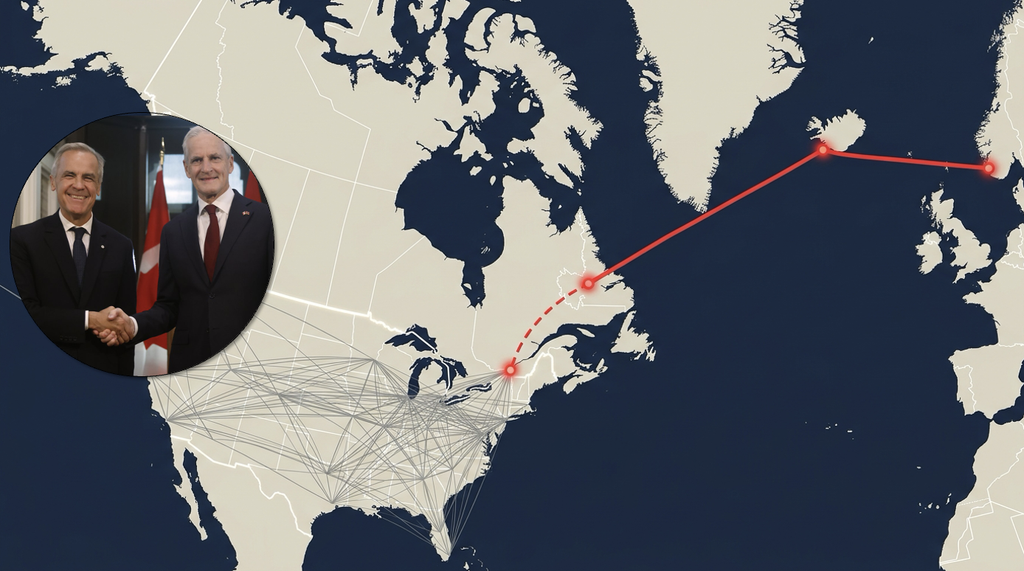
Bulk Infrastructure is looking for a Canadian strategic partner to take majority ownership of the Leif Erikson system, a proposed fibre-optic cable between Europe and Canada that wouldn’t pass through the United States, Bloomberg reported on 19 October. The project is named after the Norse explorer who reached North America about a thousand years ago, and it would follow roughly the same direction:
- It would start at the southern tip of Norway.
- It would cross 4,600 km of the Atlantic to land at Happy Valley-Goose Bay, in Newfoundland and Labrador.
- From there it would run 1,900 km underground through Quebec to Montreal.
The project is expected to cost more than $620 million. It was in the prospectus presented to global investors at Ottawa’s Canada Investment Summit in Toronto in September, where it was described as offering “direct, secure, high-capacity data transmission for AI, telecom and hyperscale markets.”
“It needs to be a Canadian sovereign cable system,” said Peder Nærbø, Bulk’s founder and executive chair, who has been working on the idea for more than half a decade. “Canada lacks resilience. The game-changer was when the current situation with the US escalated.”
Why now, and what stands in the way
Nærbø first approached Canadian governments about five years ago, but the money wasn’t there. What has changed is the politics. Trump’s threats against Canadian sovereignty have pushed Prime Minister Mark Carney’s government to review how much of the country’s communications depend on American infrastructure.
Europe has its own reasons to want the cable. Much of the data traffic between Europe and Asia runs through the Red Sea, where conflict has put cables at risk. “There’s deliberate sabotage of cables and other types of challenges with shipping, anchoring and so on,” Nærbø said of the Middle East. Bulk says more undersea links could later be built between Canada and Asia, turning Canada into a route between the two continents rather than an extension of the American network.
Bulk has the experience. Over the past 15 years it has built more than 10,000 km of undersea and land fibre cables, and it operates data centres in the Nordics. Its pitch is built on what Norway and eastern Canada have in common: plenty of hydroelectric power and a cold climate that cuts the energy data centres need for cooling.
“Quebec and Labrador, together with the Nordics, would be a perfect place to run, operate and compute at large scale on behalf of the continents of North America and Europe,” Nærbø said.
The company also has a Canadian connection already. BGO, a subsidiary of Sun Life Financial, owns 65% of Bulk through two funds, and some Canadian pension plans are invested in the company through BGO.
Ottawa and Brussels are moving in the same direction. A joint statement that Canada and the European Union plan to endorse at their summit in Montreal on 29–30 October commits them to study “the best way to enhance digital links between Europe, Canada and Asia through new subsea cable infrastructure.”
Erin O’Toole, the former Conservative leader who now heads North American operations at the risk advisory firm ADIT, said Canada needs “resilient and sovereign connectivity,” including both undersea cables and satellites. “Subsea connectivity between Canada and Europe should be a key part of growing trade and security collaboration the Prime Minister is proposing with the EU,” he said.
Industry Minister Mélanie Joly met Nærbø in Norway earlier this year. Her department declined to comment on the project but said the security and resilience of Canada’s telecommunications infrastructure are key priorities. Nærbø says Bulk has also been in contact with Canada’s Major Projects Office, government investment vehicles and some of the country’s largest telecom companies. Rogers and Telus did not respond to Bloomberg’s requests for comment, and BCE declined to comment.
The project isn’t funded yet. Vendors have signed on, but the route still needs studies backed by Canada and the EU, along with customer commitments and financing. The 1,900 km land section faces its own hurdles: it will need permits and the support of Indigenous communities along the way.
It follows two other moves away from American-controlled networks.
In August, Ottawa awarded Telesat a C$2.3 billion contract for military satellite communications across the Arctic. The deal adds 69 satellites to Telesat’s Lightspeed network, built by MDA Space in Montreal, with service due to start in 2028. The satellites will still be launched on SpaceX rockets.
In September, Carney told the New York Times: “Starlink, we will diversify away from, no question.”
The Canada–EU summit opens in Montreal on 29 October.
Sources
- Bloomberg, “Norway Data Center Firm Hunts for Partner on Canada-Europe Fiber Link,” by Mathieu Dion, 19 October 2026
- Leif Erikson system — Bulk Infrastructure
- Carney says “no question” Canada will diversify from Starlink — MobileSyrup, 25 September 2026
- Telesat secures $2.3 billion Arctic military satcom contract — Telesat via BNN Bloomberg, 4 August 2026
- Ottawa awards Telesat $2.3B Arctic military satellite contract — CP24/The Canadian Press, 4 August 2026
- Canada–Telesat Arctic communications — The Defense Post, 5 August 2026