
After a 50 per cent tariff, Canadian shipments to Europe nearly quadrupled, while American buyers now pay about 80 per cent above the world price for a metal the United States cannot produce enough of.
Buy a can of beer in the United States, and you are holding some of the most expensive aluminum on the planet.
That was not the idea. When Donald Trump raised his tariff on Canadian aluminum to fifty per cent, the promise was that America would become more self-reliant, that its own smelters would revive, and that Canada would pay. Tariffs, he has said repeatedly, are his “favourite word,” because they have “made us rich.”
More than a year later, the numbers tell a different story. Canada found other customers. American factories did not fill the gap. And American buyers are paying a record surcharge for the metal they still need.
Start with where the aluminum went.
Canada is one of the world’s largest aluminum producers, with most of its smelters in Quebec, powered by cheap hydroelectricity. For decades, nearly all of it went south. Then the tariff hit, and Canadian producers began looking elsewhere.
In 2024, the European Union imported about 159,000 tonnes of Canadian aluminum. In 2025, it imported about 592,000 tonnes, an increase of 273 per cent, according to official trade data compiled by the industry publication AL Circle.
Over the same period, shipments to the United States fell by about 24 per cent, from roughly 3.15 million tonnes to 2.4 million.
The shift has continued this year. From January to May 2026, Canadian aluminum shipments to the United States fell by another 23 per cent compared with a year earlier, while EU imports from Canada nearly quadrupled again in the first four months.
Part of the reason is price. European buyers have been paying high premiums of their own, pushed up in part by the war in Iran and its effect on energy and shipping. As Reuters put it in May, Canada is pushing more of its aluminum towards Europe “to make the most of higher premiums on offer.” The tariff made the American market less attractive. Europe made itself more attractive. Canadian producers followed the money.
The gap America cannot close
None of this would matter much if the United States could make its own aluminum. It cannot, at least not yet.
The United States produces about 660,000 tonnes of primary aluminum a year. It uses about 5.7 million. That leaves roughly four million tonnes that must be imported every year, and Canada, by Reuters’ estimate, can supply about three-quarters of that.
Building new smelters takes years and requires large amounts of cheap, reliable electricity, which much of the United States does not have. So American manufacturers, from can makers to car companies, have had little choice but to keep buying Canadian metal and paying the tariff, or to buy from elsewhere at similar cost.
That cost shows up in a number most consumers have never heard of: the Midwest premium.
Aluminum is priced worldwide on the London Metal Exchange. In mid-October, that price was about US$3,000 a tonne. But American buyers do not pay the world price. On top of it, they pay the Midwest premium, which covers delivery to the US market and, since the tariffs, most of the tariff cost as well.
On the thirteenth of October, the price reporting agency Fastmarkets assessed the Midwest premium at between US$1.06 and US$1.08 a pound, roughly US$2,350 a tonne. Put the two together, and American buyers are paying about 80 per cent more than the world price for the same metal.
The premium passed one dollar a pound for the first time in January. In June, it hit a record of US$1.19.
Not all of that is the tariff. The premium also reflects freight, insurance and tight global supply. But analysts attribute most of the jump to the fifty per cent duty, and it has stayed high for as long as the tariff has.
Who pays
The answer, increasingly, is American shoppers.
Can makers have mostly passed the higher cost on to their customers, according to the trade publication Packaging Dive, and canned foods saw some of the sharpest grocery price increases at the end of 2025. Ball Corporation, one of the largest can makers, expects “some direct tariff cost in 2026.” Crown Holdings says aluminum prices are “up significantly.” The Can Manufacturers Institute has warned: “We expect greater price increases in 2026 than we saw last year.”
Even a trade deal with Canada would not bring prices down quickly. In August, a proposal to cut the tariff on Canadian aluminum to 25 per cent collapsed along with the wider trade talks. And in September, Alcoa, America’s biggest aluminum producer, said that even if the Canada tariff were cut, the premium “might come off a little bit, but we wouldn’t see it returning to pre-tariff levels.”
Meanwhile, the American industry is asking for more protection, not less. The US Aluminum Association wants Canada and Mexico to match American tariffs on aluminum from outside North America.
Politically, the pressure is building. After last week’s midterm elections, the Democrats who will take control of Congress in January say they intend to end Trump’s tariffs on Canada. But Trump can veto any bill, and for now the tariff stays.
The result is an outcome nobody promised. Canada, the country the tariff was supposed to punish, has found new buyers across the Atlantic. The United States, the country it was supposed to protect, still cannot make enough of its own aluminum, and its manufacturers and shoppers are paying the highest premium on record.
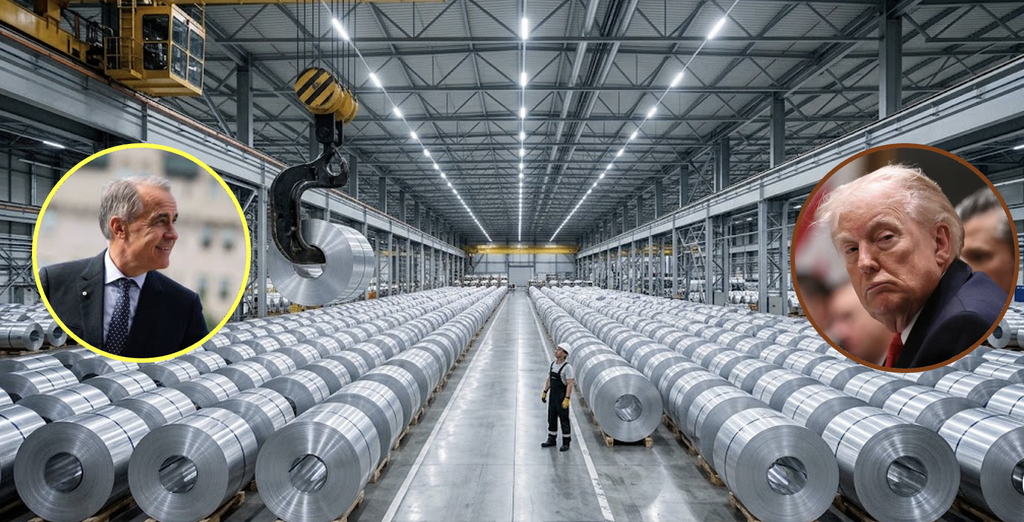
Trump calls tariffs his favourite word.
Canada sold its aluminum elsewhere. Americans are paying the difference.
Sources
- US vs EU: who is leading as Canada’s aluminium trading country in 2026 — AL Circle, 13 August 2026
- Canada turns from US to Europe as Iran war propels aluminum higher — CTV News / Reuters, 27 May 2026
- Canadian aluminum finds home in Europe amid volatile US market — S&P Global, 4 February 2026
- Cutting Canada tariffs alone won’t flatten US aluminum premium, Alcoa says — Kitco / Reuters, 10 September 2026
- Aluminium premiums may split if US cuts Canada tariff (citing Fastmarkets and the LME) — Discovery Alert, October 2026
- US aluminum: trade uncertainty, supply tightness push Midwest Premium above $1/lb — S&P Global, 26 January 2026
- High Midwest Premium, ongoing tariffs, Iran conflict hit aluminum — Packaging Dive, 4 March 2026
- Aluminum premium drops as US plans to cut tariffs on Canadian metal — Bloomberg, 20 August 2026
- CBC News, “Senior Democratic congressman says party ‘going to put an end’ to Trump’s tariffs,” 4 November 2026
- CBC News, “Trump to swap some tariffs on Canadian goods amid midterm pressure,” 23 October 2026