
The deepest natural harbour on the continent sits 500 nautical miles closer to Asia than any other West Coast port. A $750 million export facility opened there four weeks ago. And American coal reaches the world through a Canadian port.
Last month the White House published a document containing a single, unambiguous sentence: without the United States, Canada could not survive.
That is a claim about dependence, which makes it testable. Not by argument, but by looking at what is physically being built and what is physically standing.
The best place to start is the north coast of British Columbia.
Geography that nobody decided
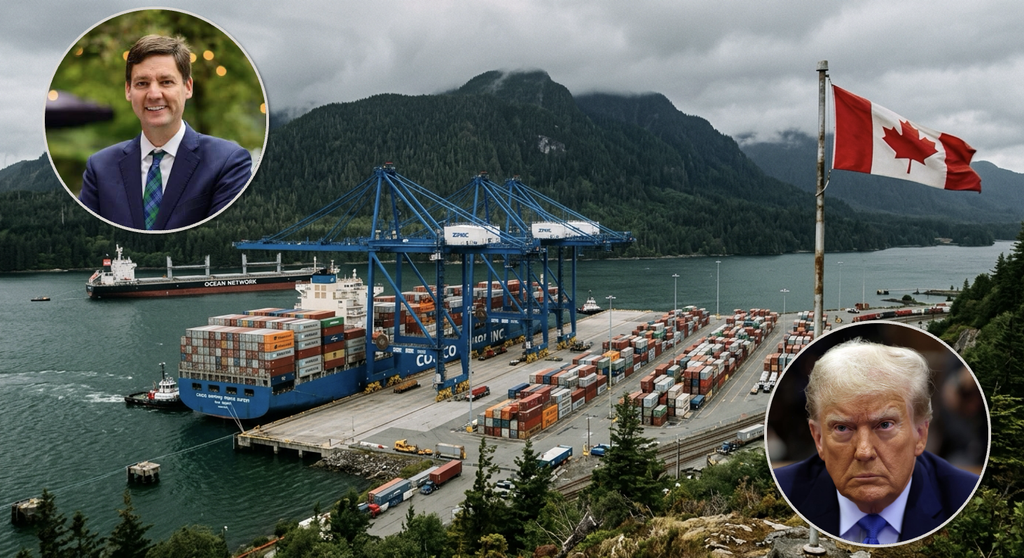
The Port of Prince Rupert sits closer to Asia than any other West Coast port in North America. Roughly 500 nautical miles nearer than the alternatives, which works out to about sixty hours of sailing saved on every crossing.
It is also the deepest natural harbour on the continent, and it does not freeze.
None of that was created by policy, and none of it can be removed by one. A tariff can change what crosses a border. It cannot move a harbour.
The traffic reflects it. Last year Prince Rupert handled 26.3 million tonnes of cargo, a rise of 14 per cent, with container traffic up 20 per cent. Around $60 billion of trade moves through it annually.
For most of its history that advantage was underused, because the customer was to the south and the infrastructure pointed that way. What has changed is that Canada has started spending money on the other direction.
CANXPORT
Four weeks ago, a new facility opened at the port.
CANXPORT is a $750 million export logistics operation run by Ray-Mont Logistics of Montreal. Its function is unglamorous and important: it takes goods arriving by rail and loads them into shipping containers. Petrochemicals, forestry products, agricultural goods, mining output.
That step is usually the bottleneck. Bulk cargo arrives from the interior by train. Containers leave by sea. Somebody has to do the transfer, and if there is nowhere to do it, capacity sits idle regardless of how many ships are available.
The first phase adds five million tonnes of export capacity without a single new berth being constructed. By 2030 it should handle around 65 per cent of the port’s containerised exports.
The financing is worth noting because of who is in it. A $150 million loan from the Canada Infrastructure Bank, roughly $50 million from the National Trade Corridors Fund, and $25 million from British Columbia. Federal, provincial and a Crown lender, alongside private capital from a Quebec company, on the coast of British Columbia.
The railway behind it
A port is only as useful as what can reach it, which is why most of the spending is inland.
Canadian National is running a capital programme of more than $2.8 billion aimed specifically at western bottlenecks.
The critical piece is the Edson Subdivision, the single line carrying every westbound train heading to both Vancouver and Prince Rupert. It is now roughly two-thirds double-tracked, which has added about seven trains a day.
Seven trains a day sounds small. On a line where every westbound movement to two major ports has to pass, it is the difference between a functioning corridor and a queue.
Canada’s rail network is the fifth-largest in the world: 49,000 kilometres of track, carrying 900 million tonnes of freight worth roughly $400 billion a year.
The coal that nobody mentions
Here is the part of the story that involves leverage rather than construction.
Coal is the largest export by volume at both Vancouver and Prince Rupert. A substantial share of it is not Canadian.
Thermal coal mined in Montana travels north by rail and leaves through the Westshore Terminal at Roberts Bank, south of Vancouver. Last year that amounted to 14.8 million tonnes.
The reason it takes that route is straightforward, and Premier David Eby has stated it plainly: the Americans cannot get it out through any of their own ports, and they will not ship it themselves.
American coal reaches world markets through a Canadian harbour.
Those exports are already scheduled to be phased out by 2030. Eby has asked Ottawa to consider accelerating that timeline, and to examine restricting the shipments in response to the tariffs.
It is worth separating this from Canada’s own coal exports, which are overwhelmingly metallurgical coal for steelmaking rather than thermal coal for power stations. Canada shipped 24.8 million tonnes last year, earning an average of $628 million a month, mostly to South Korea, Japan and China.
So the leverage is real and specific. Whether it can actually be used is a different question.
Why this takes years
Expanding export capacity is not a decision anyone announces. It is construction, and construction runs on its own clock.
The bridge. The rail bridge into Prince Rupert caps the port at 24 trains a day. CN is replacing it with a 1,600-foot, three-track structure costing $122 million. It will not be finished until 2027.
The approaches. Double-tracking the final approaches into Vancouver finishes the same year.
The terminal. At the Port of Vancouver, the Roberts Bank Terminal Two expansion is running late.
The money. The Railway Association of Canada estimates the country needs $5 billion of trade corridor investment this year, plus $1 billion for Arctic infrastructure. Its own calculation is that this would add up to $21 billion to GDP.
And the legal problem with the coal. Eby has acknowledged it himself. Thermal coal moving through a federally regulated port is an export good, and provinces cannot tax exports. A previous British Columbia premier floated a similar levy in 2017 during the softwood lumber dispute. Nothing came of it.
That last constraint matters more than it might appear. The single clearest piece of leverage Canada holds on the West Coast sits in a jurisdictional space where the province that hosts it cannot act alone and the federal government has not chosen to.
What it adds up to
None of the limits are permanent. Bridges get built. Track gets doubled. Terminals open, and CANXPORT opened four weeks ago, which means that capacity exists now rather than in a projection.
But the timelines explain why diversification is measured in years rather than months, and why announcements keep outrunning throughput. Arctic Gateway’s chief executive made the point in a different context: growing Canada’s non-American trade by ten percentage points would require port capacity equivalent to roughly four times the Port of Vancouver. That is not a policy problem. It is a concrete-and-steel problem.
So return to the sentence the White House published.
Canada is building the capacity to sell elsewhere, and some of it is already standing. The port best positioned to do it is the closest point on this continent to Asia, and that remains true regardless of what Washington decides. American coal still leaves through a Canadian harbour because there is no American alternative.
What Canada does not yet have is enough of it, quickly enough.
That is a very different problem from not being able to survive.
Sources