
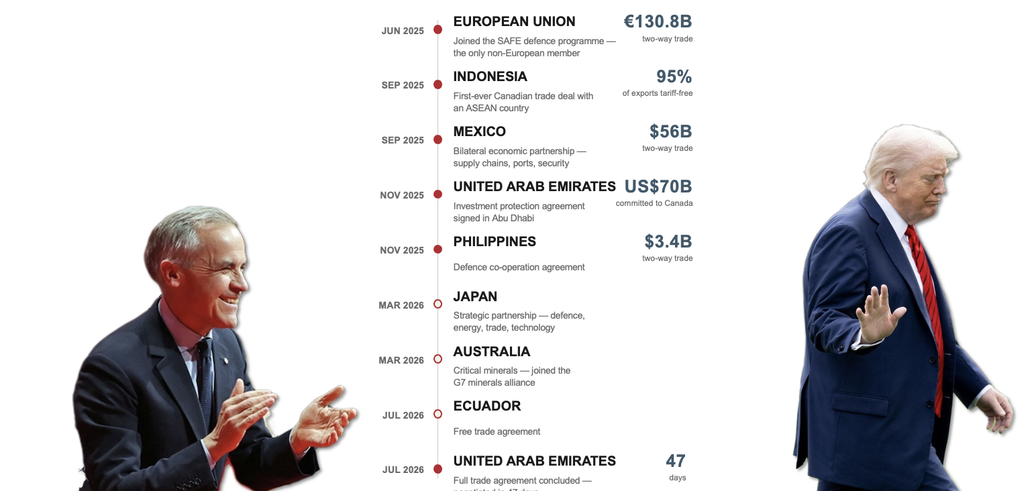
On 18 March 2025, four days after Mark Carney took office, Donald Trump called Canada one of the nastiest countries to deal with and said America needed nothing it had. Since then Canada has signed agreements with eight partners. One took forty-seven days.
Laura Ingraham put it to him plainly on Fox News: was he being tougher on Canada than on America’s adversaries?
“I deal with every country, indirectly or directly. One of the nastiest countries to deal with is Canada. Canada was meant to be the 51st state because we subsidize Canada by $200 billion a year.”
Then the part that has aged least well:
“We don’t need their lumber, we don’t need their energy, we don’t need anything. We certainly don’t want their automobiles.”
And asked directly whether Canada was getting harsher treatment than America’s rivals:
“Only because it’s meant to be our 51st state.”
The interview aired on the evening of 18 March 2025. Mark Carney had been sworn in on 14 March.
What follows is what Canada has signed since — every agreement, in order, with the numbers attached.
What was signed
June 2025 — European Union
Canada joined SAFE, the European Union’s Security Action for Europe programme, which lends member states money to buy weapons. Canada is the only non-European participant. Member states endorsed the participation agreement in December 2025; the Council cleared the final path in February 2026.
The commercial effect arrived quickly. In June 2026, Montreal-based Marconi Technologies secured the first Canadian contract under the programme.
The relationship it sits on top of is already the largest on this list. Two-way trade between Canada and the EU reached €130.8 billion in 2025 — €81.8 billion in goods and €49.1 billion in services. Since CETA took provisional effect in 2016, goods trade has grown 76 per cent, services 90 per cent, and the relationship overall 81.2 per cent. CETA abolished 98 per cent of tariffs between the two.
The investment stock is larger still: €244.7 billion of European direct investment in Canada, and €230 billion of Canadian investment in Europe.
In September 2026, at the European Parliament in Strasbourg, the door was opened to something further — Canada becoming an associate member of the European Union’s single market arrangements. That has not been agreed. It has been raised.
September 2025 — Indonesia
Canada’s first-ever bilateral trade agreement with an ASEAN country, announced on 24 September 2025 and entering force in 2026.
Tariffs will be cut or eliminated on more than 95 per cent of what Canada currently sells to Indonesia. The named beneficiaries are wheat, potash, wood and soybeans — the things Canada digs up and grows.
Two-way merchandise trade stood at $5.6 billion in 2024, with $2.3 billion of that Canadian exports. Indonesia is Canada’s third-largest Southeast Asian trading partner and eighteenth globally.
The scale argument is about where Indonesia is going rather than where it is. Population 282 million. GDP around $1.9 trillion in 2024. Projected to be a top-five global economy by 2050.
Export Development Canada attached money to the agreement: up to $825 million in debt financing to the Indonesia Investment Authority, directed at infrastructure, digital services, renewable energy and advanced manufacturing.
September 2025 — Mexico
A bilateral economic partnership signed between Carney and President Claudia Sheinbaum, and notable less for its size than for what it is designed to route around.
Two-way trade: $56 billion in 2024. Canadian direct investment in Mexico: $46 billion. Canada is Mexico’s fifth-largest trading partner; Mexico is Canada’s third.
The agreement covers supply chain diversification, joint production aimed at Latin American and Asian markets, security cooperation against synthetic opioid trafficking, migrant worker programmes, health and energy. It also covers direct port access for Mexico, explicitly to reduce dependence on American maritime channels.
Two of North America’s three economies, agreeing how to trade with each other without the third, ahead of the 2026 review of the continental agreement that binds all of them.
November 2025 — United Arab Emirates
Carney signed a Foreign Investment Promotion and Protection Agreement in Abu Dhabi on 21 November 2025 with UAE President Sheikh Mohamed bin Zayed Al Nahyan.
Alongside it came the single largest figure in this account: a UAE commitment to invest US$70 billion — roughly C$94 billion — into Canada. The named sectors are critical minerals, energy, ports and artificial intelligence, with engineering, aerospace, agri-food, seafood and data infrastructure also listed.
Current two-way trade is $3.4 billion. The stated target is $7 billion within a decade. The precedent cited is Canada’s agreements with South Korea and Chile, each of which doubled trade inside ten years.
Canadian pension funds, holding roughly $2 trillion in capital, were brought into the arrangement to engage directly with Emirati investors. Additional direct commercial flights were announced.
November 2025 — Philippines
A defence co-operation agreement covering collaboration between the two countries’ armed forces on operations and exercises.
Two-way trade in 2025: $3.4 billion — $1.1 billion in Canadian exports against $2.3 billion in imports. A separate free trade agreement is under negotiation, advanced at consultations in Manila on 21–22 September 2026.
February 2026 — South Korea, Germany, Denmark
Three agreements in one month, none of them trade agreements in the conventional sense.
South Korea: an arrangement governing the exchange of classified military and defence information.
Germany: a joint declaration on artificial intelligence, framed around technology sovereignty.
Denmark: a military-industrial memorandum of understanding.
March 2026 — Japan
A strategic partnership agreement spanning defence, energy, trade and technology — the broadest single framework Canada has signed in the Indo-Pacific.
March 2026 — Australia
Critical minerals agreements, alongside Australia’s accession to the G7 critical minerals alliance. Two of the world’s largest mineral producers, coordinating supply rather than competing for the same buyers.
June 2026 — France
A general security of information agreement, which in practice expands Canadian access to French defence procurement.
July 2026 — Ecuador
A free trade agreement, eliminating tariffs and reducing barriers.
July 2026 — United Arab Emirates, again
The full Comprehensive Economic Partnership Agreement concluded, eight months after the investment treaty.
Negotiations took 47 days.
What is not signed
The two largest prizes are still open, and both are bigger than almost everything above.
India. A Comprehensive Economic Partnership Agreement is four negotiating rounds in, with both governments aiming to conclude by the end of 2026. Two-way trade: $30.4 billion, of which $13.6 billion is merchandise. Trade Minister Maninder Sidhu met his counterpart Piyush Goyal in Ottawa in May and again at the G20 trade meeting.
ASEAN. A bloc-wide free trade agreement remains under negotiation. Canada–ASEAN trade reached $52.5 billion in 2025, up 23.7 per cent on 2024 — the fastest-growing major relationship Canada has.
Together those two are worth about $83 billion in annual two-way trade.
Behind them sit the Philippines, Thailand, Turkey and Mercosur, plus foreign investment agreements under negotiation with Argentina, Pakistan, Qatar, Tanzania, Saudi Arabia, Uruguay and Zambia.
The numbers underneath
Diversification is usually announced. Occasionally it is measured. This year it has been measured.
Canada’s trade with countries other than the United States rose 17 per cent in the past year, worth $33 billion. Nearly one-third of Canadian exports now go somewhere other than the United States — the highest share in forty years.
In July 2026, exports to non-American markets hit a record $25.6 billion, up 7.4 per cent on the month and rising for the third month running. That was 33.7 per cent of everything Canada sold abroad. The American share of Canadian goods exports fell to 66.3 per cent.
Three markets did most of the work, and the products say what kind of economy is doing the diversifying. The Netherlands took more iron ore, nuclear fuel and crude. Germany took more copper ore. China increased across a broad spread.
Canada’s trade deficit with non-American countries narrowed from $6.1 billion in June to $5.1 billion in July — the lowest since January 2021.
One more figure, since the interview raised it. Trump put the American subsidy to Canada at $200 billion a year. In July 2026, the month of the most recent full trade release, Canada’s goods trade surplus with the United States was $5.9 billion, down from $10.3 billion in June.
Where it stands
Formal trade negotiations between Canada and the United States collapsed on 22 August 2026 and none have been scheduled since. On 29 September, an American import ban took effect on roughly $1 billion of Canadian goods, of which 87 per cent by value is alcohol.
That same week, White House trade adviser Peter Navarro told Canadian lobbyists at a Washington conference to “get the hell out of the country,” before adding: “I love the Canadian people. I do not love the Canadian negotiators.”
The day before, Donald Trump predicted a Canadian deal within three or four weeks: “They’re gonna come in and they’re gonna say, ‘Sir, we are sorry.'”
In the eighteen months since he said America did not need Canadian lumber, Canadian energy, or anything else Canada had, Canada has signed agreements with the European Union, Indonesia, Mexico, the United Arab Emirates twice, the Philippines, South Korea, Germany, Denmark, Japan, Australia, France and Ecuador.
The United Arab Emirates needed forty-seven days.
Sources
- “One of the nastiest countries”: What Donald Trump said about Canada to Laura Ingraham, Yahoo News Canada
- As Carney pivots trade from U.S., here are some of Canada’s new deals, The Canadian Press
- Prime Minister Carney announces new trade agreement with Indonesia, Prime Minister of Canada
- Prime Minister Carney secures new agreements with the United Arab Emirates, Prime Minister of Canada
- EU-Canada trade: facts and figures, Council of the European Union
- SAFE: member states endorse agreement on the participation of Canada, Council of the European Union
- Canada advances trade talks on agreements with India, ASEAN, and the Philippines, Global Affairs Canada
- Mexico and Canada Sign Bilateral Economic Agreement, Global Finance
- G20 trade ministers are meeting in Wisconsin. Many will be discussing deals without their U.S. host, CBC News
- Canadian international merchandise trade, July 2026, Statistics Canada
- Navarro Tells Canadian Lobbyists to ‘Get the Hell Out’ of US, Bloomberg