
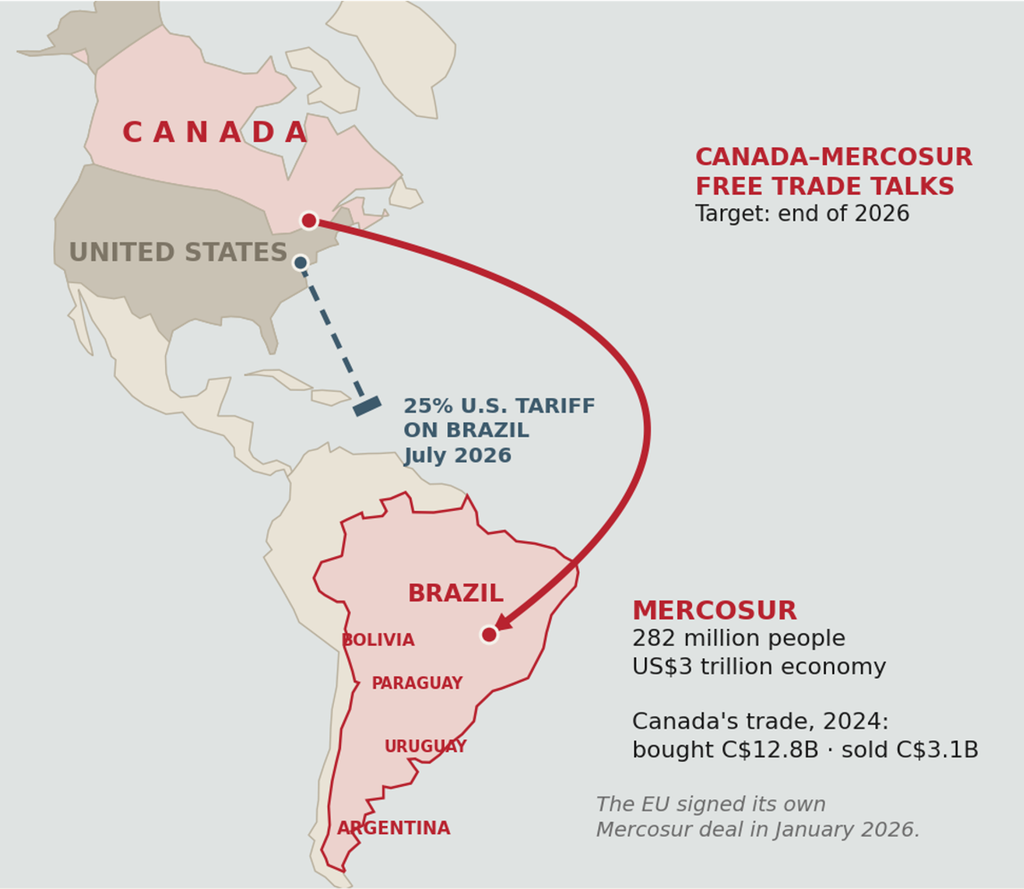
In July, the United States put a 25 per cent tariff on Brazilian goods. Ottawa is aiming to sign a free trade agreement with Brazil and its South American partners by December: a market of 282 million people and a US$3 trillion economy.
On the fifteenth of July, the Office of the US Trade Representative announced a 25 per cent tariff on Brazilian goods.
It listed six reasons: Brazil’s rules on digital trade and electronic payments, what it called unfair preferential tariffs, backsliding on anti-corruption enforcement, weak intellectual property protection, restricted access for American ethanol, and illegal deforestation.
In the same statement, Washington described what it was taxing:
“Brazil’s unfair trading practices have prevented U.S. workers and producers from accessing this important market with over 210 million consumers.”
It added that “extensive negotiations with Brazil over the past year have not resolved these issues.”
Canada is negotiating to enter that same market, without tariffs.
What Washington Did
The tariff on Brazil came through an unusual route.
On the twentieth of February 2026, in Learning Resources v. Trump, the Supreme Court ruled that the president cannot impose tariffs under the International Emergency Economic Powers Act, the law behind most of the country-by-country tariffs of his second term.
Five months later, the administration used a different law, Section 301 of the Trade Act of 1974, which lets the US Trade Representative act against foreign practices it judges unreasonable. Brazil was its target.
The 25 per cent applies to certain goods of Brazil, and the duty took effect in late July.
Brazil had already been finding other buyers. Its exports to Canada reached a record US$7.25 billion in 2025, up 15 per cent on the year before. The leading products were:
- Gold bullion: US$1.35 billion in the first half of 2025 alone
- Green coffee
- Beef and pork
- Iron and nickel
Trade between the two runs heavily one way. In 2024, according to Global Affairs Canada:
- Canada bought C$12.8 billion from the Mercosur bloc
- Canada sold C$3.1 billion to it
- Two-way trade: C$15.8 billion
For every dollar Canada sells to the bloc, it buys about four.
What Ottawa Is Doing
Mercosur, the Southern Common Market, groups Argentina, Bolivia, Brazil, Paraguay and Uruguay. Together they have 282 million people and a combined economy of more than US$3 trillion.
Canada and Mercosur launched free trade negotiations in March 2018. The talks stalled for years. They restarted in 2025, after American tariffs gave both sides a reason to look elsewhere.
They have moved quickly since. By the end of March 2026, officials described the talks as advancing “at record speed,” with negotiating teams meeting about every six weeks.
On the twentieth of April, a Brazilian official said both sides were aiming to sign the agreement in 2026.
On the sixteenth of July, Foreign Minister Anita Anand said:
“We have agreed to intensify FTA negotiations with the objective of concluding negotiations … ideally before the end of 2026.”
Brazil’s Foreign Minister Mauro Vieira was more cautious: “There are still some details to be worked out.”
Anand also set out the larger goal: “We’re going to double non-U.S. trade agreements in the coming decades.”
Canada isn’t first in line. The European Union signed its own agreement with Mercosur in January 2026, and it has applied provisionally since the first of May.
Mercosur is one of three agreements Ottawa wants to conclude this year. In May, Trade Minister Maninder Sidhu named them:
- Mercosur: 282 million people
- India: two-way trade of C$30.4 billion in 2025, with a target of C$70 billion by 2030. The fifth round of talks opens in Ottawa on the fifth of October.
- ASEAN: the 10-member Association of Southeast Asian Nations
“We’re negotiating as fast as possible,” Sidhu said. “We can’t miss this opportunity and we need to make sure that our businesses have just as much preferential access.”
The numbers behind the push:
- Canadian exports to countries other than the United States rose by C$33 billion in 2025
- Ottawa’s stated goal is to double non-US exports over the next decade
- Since March 2025, Prime Minister Mark Carney has made 17 trips to 25 countries
In July, Washington put a 25 per cent tariff on Brazilian goods, describing Brazil as an important market of more than 210 million consumers.
The same month, Canada agreed to intensify its talks to open that market, and the four others in the bloc, to Canadian exporters.
The target date is December.
Sources
- USTR Section 301 Action on Brazil’s Unreasonable Acts, Policies, and Practices — USTR, 15 July 2026
- U.S. slaps 25% tariff on most Brazilian goods over ‘unfair trade practices’ — CNBC, 16 July 2026
- After the Supreme Court killed his first tariffs, Trump turns to a new legal workaround — Fortune, 17 July 2026
- Brazil Section 301 Tariffs: 25% Duty Starts July 22 — Global Logistical Connections
- Supreme Court Strikes Down IEEPA Tariffs — WilmerHale, 20 February 2026
- Brazil sets record exports to Canada in 2025, up 15% — DatamarNews
- Canada–Mercosur Free Trade Agreement — Global Affairs Canada
- Progress Intensifies in Canada–Mercosur FTA Negotiations — GRLLP, March 2026
- Canada, Mercosur aiming to sign free trade deal this year: Brazilian official — CTV / The Canadian Press, 20 April 2026
- Canada wants to close Mercosur deal before end of 2026 — Canadian Affairs, 16 July 2026
- Canada nears free-trade deal with Mercosur bloc by end of 2026 — The Deep Dive, 27 March 2026
- Canada looking to wrap a trio of trade deals this year: minister — BNN Bloomberg / The Canadian Press, 2 May 2026
- Canada advances trade talks on CEPA with India — Global Affairs Canada, 21 September 2026
- Canada eyes $70 billion trade with India in 5 years — The Tribune, 2 October 2026