
Only 16 F-35s are locked in. A decision on the rest is expected after the US midterms, and Sweden is offering to build its Gripen in Canada instead. Here is what each option would cost, and what each can do.
The US midterm elections are a week away. According to sources, that is when Ottawa plans to decide what to do with 72 American fighter jets.
Prime Minister Mark Carney ordered a review of Canada’s F-35 purchase in March 2025. Nineteen months later, there is still no decision.
The original plan was simple. In January 2023, Canada signed for 88 Lockheed Martin F-35s, in a contract worth about C$19 billion. The Auditor General has since estimated that the full purchase could cost C$27.7 billion. The first 16 jets are locked in and in production, due for pilot training late this year. The other 72 are under review, and National Defence says every option remains open, including a mixed fleet.
The announcement is reportedly being held until after the midterms on 3 November, to avoid inflaming relations with Washington beforehand. Carney could also use the jets as leverage in trade talks. The final call is his.
So the comparison is no longer theoretical.
What it costs to fly
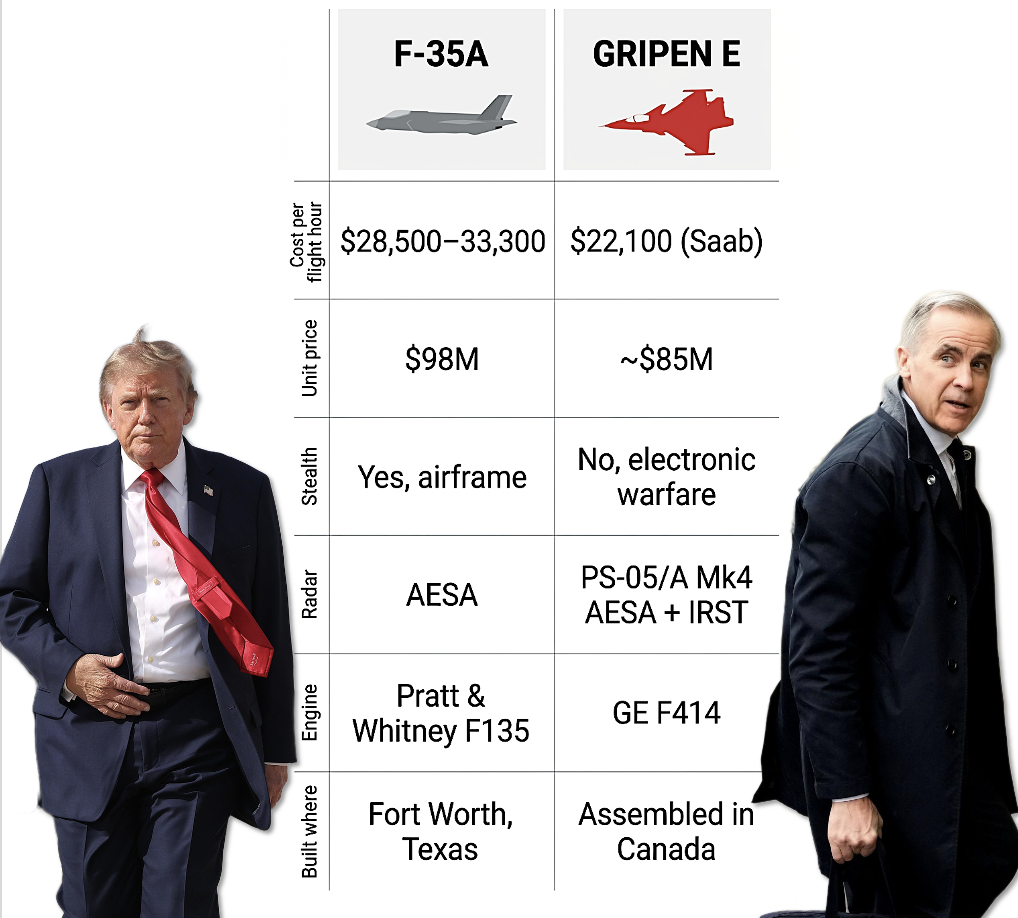
The argument mostly comes down to one number: what each aircraft costs to operate. The published figures vary widely, depending on who produced them.
- F-35A: about US$28,500 an hour, according to US Department of Defense data, with other US Air Force figures around US$33,300. The US Government Accountability Office’s estimate of the programme’s lifetime sustainment costs rose from $1.1 trillion in 2018 to $1.58 trillion in 2023.
- Gripen E: about US$22,100 an hour, by Saab’s own figure, covering maintenance, fuel, crew and logistics. Independent analysts note that Saab’s baseline is built on Swedish Air Force operations, so it remains an estimate.
The most useful comparison comes from a government that chose the F-35 anyway. In 2023, the Czech defence ministry costed two fleets of 24 aircraft each:
- Gripen E/F: about US$174 million a year, or US$7.25 million per aircraft.
- F-35: about US$231 million a year, or US$9.6 million per aircraft.
That makes the Gripen roughly 25% cheaper to operate. Prague bought the F-35.
Purchase prices are closer than the operating costs. The Gripen E has been quoted in the mid-US$80 million range per aircraft. Lockheed Martin puts the F-35A at about US$98 million.
One caution matters more than any single figure: no independent audit has compared both aircraft on the same basis. That is why the numbers disagree so widely, and why both sides can claim the advantage.
What isn’t in dispute is that the two jets are built on very different ideas.
The F-35 relies on stealth. Its shape and coatings make it very hard for enemy radar to detect, and it carries one of the most advanced sensor suites in the world. That is why most of NATO’s air forces have bought it.
The Gripen E has no stealth airframe. It relies on sensors and electronic warfare to survive instead:
- Electronic warfare: its Arexis system is designed to detect, jam and deceive threats in every direction before they can fire.
- Sensors: an advanced radar, plus an infrared sensor that lets it track targets without giving away its own position.
- Engine and range: the American-made GE F414 engine, with about 30% more internal fuel than the older Gripen C/D.
The Gripen E entered Swedish service in October 2025.
Its design idea matters most for Canada. Sweden built the Gripen knowing it could never outspend a much larger neighbour, so it was made to operate from scattered, improvised bases. A small ground crew can refuel and rearm one on a public road in under 20 minutes.
That is the case for a mixed fleet: Gripens for Arctic patrols and sovereignty flights, which make up most of the Royal Canadian Air Force’s work, and F-35s for the missions that need stealth.
Saab’s offer also goes well beyond the aircraft. It proposes building Gripens in Canada, from parts to finished jets:
- Jobs: about 12,600, tied to a purchase of 72 Gripens and six GlobalEye surveillance aircraft.
- Suppliers: about 10 prime partners and around 250 suppliers across several provinces.
- Where the work goes: combining Gripen and GlobalEye, 50% to Quebec, 26% to Ontario, 14% to the West and 10% to Atlantic Canada.
- Exports: Saab lacks the capacity in Sweden to meet demand, and Ukraine has signalled interest in 100 to 150 Gripens. A Canadian line would build for export as well. Canada would become Saab’s third Gripen production centre, after Sweden and Brazil.
Ottawa has already shown it is willing to choose Swedish. In May, Carney named Saab’s GlobalEye the preferred choice for six airborne early-warning aircraft, worth more than C$5 billion. It was the first time Canada picked a non-American airborne surveillance system, and it is built on a Bombardier business jet assembled in Toronto. Negotiations are ongoing.
There is also a personal edge. On 31 August, US Defence Secretary Pete Hegseth posted a photo of a Canadian cadet and her instructor with the caption “this is real,” widely read as mocking their appearance. Defence Minister David McGuinty called it below the dignity of the office. The next day, asked about the fighter order, McGuinty said Canada will examine the acquisition “in its fullness.”
The decision is expected after 3 November. Whatever Ottawa chooses, 16 F-35s are already coming. What is open is whether the rest of Canada’s air force will be American, Swedish, or both.
Sources
- Office of the Auditor General of Canada, report on the F-35 acquisition
- National Defence, statements on the F-35 review
- US Department of Defense and US Air Force, F-35A operating cost data
- US Government Accountability Office, F-35 sustainment cost estimates (2018, 2023)
- Czech Ministry of Defence, fighter fleet cost comparison (2023)
- Saab, Gripen E operating cost figures and Canadian industrial proposal
- Canada wants Saab early-warning aircraft under push to retool defense suppliers — Defense News, 28 May 2026
- Saab is offering Canada jobs to buy the Gripen — 19FortyFive, September 2026
- Ottawa takes next step in negotiations on possible GlobalEye purchase — The Canadian Press, 25 September 2026